 EMERGING TECH
EMERGING TECH
EMERGING TECH










EMERGING TECH

There is still a way to go before self-driving vehicles can achieve true autonomy as defined by the U.S. Department of Transportation’s five-level automobile classification system. But according to Nvidia Corp., the processors needed to support the capability is already here.
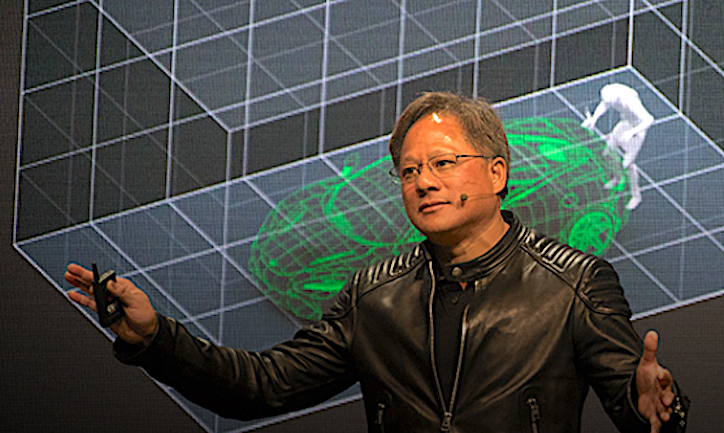
Jensen Huang (pictured), chief executive of the chip giant, today unveiled a new computing module code-named Pegasus at its GPU Technology Conference in Munich, Germany. Intended eventually to power vehicles with so-called Level 5 autonomy, the system is about the size of a license plate and can perform north of 320 trillion operations a second, more than 10 times faster than the previous-generation Drive PX 2 chip.
This extra horsepower is provided by the four processors built into the module. The first pair is from Nvidia’s Xavier system-on-chip series, which packs 7 billion transistors on a single die, while the other two are graphics accelerators of a yet-unspecified model. They’re joined by 16 inputs for connecting to the cameras, radar units and any other sensors that may be used by a self-driving vehicle.
 Nvidia said those features will enable Pegasus to efficiently handle the massive volumes of data that fully autonomous car will be expected to process. To achieve Level 5 system status, a vehicle would require the capability to navigate the roads just as skillfully as a human under all driving conditions.
Nvidia’s plans aren’t focused purely on the long term, however. The company also sees Pegasus finding use in the self-driving cars that are undergoing development today.
The chip’s high performance and small form factor could dramatically reduce the amount of space that needs to be set aside for computing equipment in a vehicle. Nvidia isn’t shy about talking up the specifications. In a press release, the company drew a contrast with some of the automobiles that use its older hardware, saying their trunks often “resemble small data centers.”
Nvidia plans to start shipping Pegasus units in the second half of 2018. More than 225 partners already use the company’s chips for autonomous vehicles, including Tesla Inc., which relies on the Drive PX 2 module to power its Autopilot feature.
Support our mission to keep content open and free by engaging with theCUBE community. Join theCUBE’s Alumni Trust Network, where technology leaders connect, share intelligence and create opportunities.
Founded by tech visionaries John Furrier and Dave Vellante, SiliconANGLE Media has built a dynamic ecosystem of industry-leading digital media brands that reach 15+ million elite tech professionals. Our new proprietary theCUBE AI Video Cloud is breaking ground in audience interaction, leveraging theCUBEai.com neural network to help technology companies make data-driven decisions and stay at the forefront of industry conversations.