







 AI
AI
AI
AI
AI

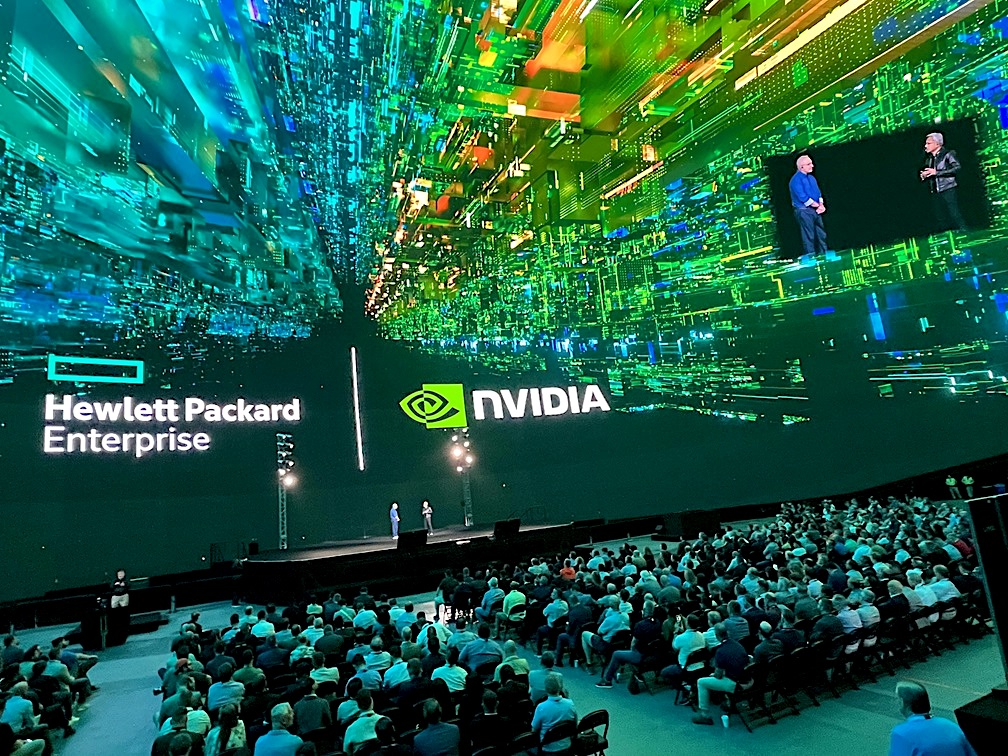
Hewlett Packard Enterprise Co. used Nvidia Corp.’s GTC conference today to roll out a broad expansion of its artificial intelligence portfolio, introducing new systems for enterprise, sovereign and high-performance computing deployments as positions itself as a full-stack supplier for organizations moving AI from pilots into production.
The announcements span private cloud systems, edge servers, large-scale AI factory infrastructure and storage.
HPE said enterprises are no longer satisfied with isolated AI experiments and instead want repeatable, governed systems that can deliver measurable returns. “The winners are not just optimizing around isolated projects,” Dale Brown, HPE’s global head of growth for AI solution sales, said in a briefing. “They’re standardizing how AI operates inside their enterprise.”
Brown said that shift is being driven by growing anxiety about the economics of AI. “It’s a little bit more fragile how the return on investment is showing up,” he said, adding that enterprises increasingly want predictable paths from infrastructure spending to business outcomes, rather than proofs of concept. “The real shift is from one-off projects to how to [repeat successful projects] again and again and again,” he said.
In response, HPE is expanding the Private Cloud AI turnkey system co-engineered with Nvidia, with new scaling options, air-gapped configurations for regulated industries and support for Nvidia’s AI-Q agentic AI blueprint and Omniverse digital twin software. The system can now scale to 128 graphics processing units through networked expansion racks. It’s positioned both for sovereign and regulated use cases such as finance, defense and healthcare.
Brown said the design goal is to make enterprise AI easier to operationalize for organizations that may lack deep in-house expertise. “We’ve removed that level of friction of designing it, integrating it, testing it, deploying it, onboarding people,” he said. “All of that is in Private Cloud AI.”
The company is also broadening support for Nvidia Blackwell GPUs across its portfolio. Nvidia’s RTX Pro 6000 Blackwell Server Edition GPUs are now standardized across HPE AI factory configurations and RTX Pro 4500 Blackwell Server Edition GPUs are available in more ProLiant server models aimed at edge deployments, small language models, vector databases and analytics.
Brown said edge deployments reflect a pragmatic view of enterprise AI. “If I’m a retail customer and I want to talk about loss prevention, I don’t need a full-scale turnkey AI factory in a retail location,” he said. A better solution is to use hardened and repeatable patterns built on larger systems and deployed in a small footprint.
HPE also unveiled new infrastructure aimed at model builders, service providers and sovereign AI initiatives. Among them is the HPE Cray Supercomputing GX240 Compute Blade, which the company believes is “the industry’s first liquid-cooled compute blade featuring up to 16 Nvidia Vera CPUs,” said Chris Davidson, vice president of HPC and AI customer solutions.
The company is also introducing the Nvidia Vera Rubin NVL72 by HPE, a rack-scale system built for models with more than a trillion parameters. The new HPE Compute XD700 is an Open Compute Project-inspired AI server based on the Nvidia HGX Rubin NVL8 liquid-cooled AI platform. Davidson said the server continues themes that run across today’s launch: density, liquid cooling and time-to-value.
The Nvidia Rubin platform is said to deliver up to a 10-fold reduction in inference token cost and a fourfold reduction in the number of GPUs required to train mixture-of-experts models compared to prior Blackwell platforms. The design allows up to 128 Rubin GPUs per rack and doubles the density of prior generations, Davidson said, translating into “more training, more inference and more performance per dollar and per watt.”
HPE is pairing the hardware introductions with software and services meant to make shared AI infrastructure easier to operate. The company said its AI Factory portfolio will support multi-tenancy models through Nvidia Multi-Instance GPU, Nvidia Mission Control software, Red Hat Enterprise Linux and OpenShift integration along with HPE services for data center design, deployment and operations. The strategy is to support customers “anywhere along their AI journey,” Davidson said.
On the storage side, HPE said its Alletra Storage MP X10000 is the object-based platform to be certified by Nvidia at the foundation level, with performance validated for configurations of up to 128 GPUs. HPE asserted that AI infrastructure bottlenecks increasingly lie in the data pipeline and inference context layer, not just in raw computing.
HPE executives said they see AI adoption becoming more operational, more distributed and more tightly governed. Brown said customers are under pressure from boards and executives to use AI, but want “low-risk decisions” and detailed, use-case-specific guidance. HPE’s response is a sprawling but increasingly integrated set of systems, software and services meant to cover everything from an air-gapped enterprise rack to a sovereign supercomputing cluster.
“It’s the right-sized AI factory,” Brown said.
Support our mission to keep content open and free by engaging with theCUBE community. Join theCUBE’s Alumni Trust Network, where technology leaders connect, share intelligence and create opportunities.
Founded by tech visionaries John Furrier and Dave Vellante, SiliconANGLE Media has built a dynamic ecosystem of industry-leading digital media brands that reach 15+ million elite tech professionals. Our new proprietary theCUBE AI Video Cloud is breaking ground in audience interaction, leveraging theCUBEai.com neural network to help technology companies make data-driven decisions and stay at the forefront of industry conversations.