 AI
AI
AI
AI









AI

The 2026 edition of Adobe Summit this week marks a historic turning point for the software giant.
It not only showcased the next frontier of “agentic artificial intelligence” but also served as the swan song for Shantanu Narayen, who delivered his final keynote as chief executive. Narayen, who has steered Adobe through the transition to the cloud and the birth of the digital experience category, used his final stage to outline a future in which AI doesn’t just assist humans — it performs work on their behalf.
Though this idea has been heard before, what was unique was the sheer scale of the data foundation Narayen presented. By connecting agentic AI to the Adobe Experience Platform — which already processes 35 trillion segment evaluations a day — Adobe isn’t just giving agents a “brain” but a complete memory of every customer interaction. This allows the AI to perform work that is contextually aware of a customer’s entire history, not just the immediate task at hand.
Here are the five key takeaways from Narayen’s presentation:
1. The dawn of the “agentic enterprise.”
Unsurprisingly, the keynote’s central theme was the shift from generative AI to agentic AI. While generative AI focuses on creating content from prompts, agentic AI is designed to execute multistep business goals. Narayen introduced Adobe CX Enterprise, an end-to-end system that uses specialized “co-workers” to identify prospects, orchestrate journeys and optimize brand visibility.
As Narayen noted during the presentation: “Tools don’t create; people do. But winning isn’t just about producing the most content. It’s about producing the right content, on brand, at scale, and delivered in a way that feels personal.”
This has always been Adobe’s calling card, and AI lets its customers do what they have always done, but now much faster.
2. Digital twins and the marriage of physical and digital AI
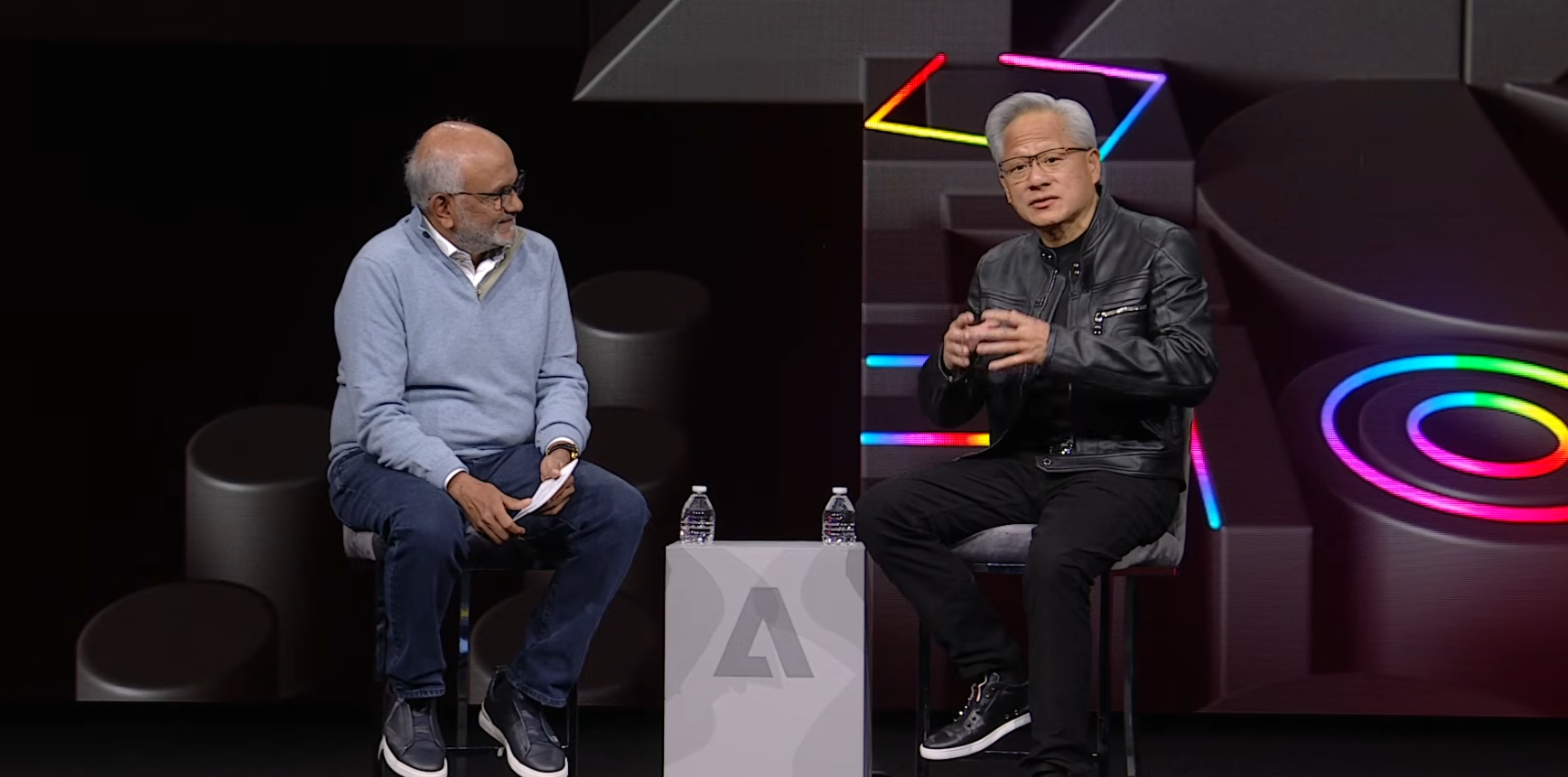
A highlight of the keynote was the appearance of Nvidia CEO Jensen Huang, a longtime friend and collaborator of Narayen. The two visionaries discussed the “Omniverse” and the necessity of high-fidelity digital representations of physical products. Huang emphasized that for AI to truly transform industries such as manufacturing and logistics, it must understand the physical world through “precision digital twins.”
Huang explained the evolution of the computing model: “In the future, you’re going to come up with a seed of an original idea, and every time your customers enjoy it, your content is going to be processed by generative AI and presented, described and illustrated in a way that is contextually sensible.”
3. Creativity is the new productivity
Narayen and David Wadhwani, president of Adobe’s Creative Business, argued that in an era flooded with “AI slop” and a “sea of sameness,” creative differentiation is the only way for brands to survive. To address the “content crunch,” where demand is expected to grow fivefold over the next two years, Adobe unveiled the Adobe Creative Agent.
This agent serves as a human-led, agent-accelerated partner that can convert a strategic brief into a creative one, source assets, and even perform complex edits in Photoshop (such as the new “Rotate Object” feature) in seconds. By automating the mundane, Adobe aims to free humans to focus on the “human insight” that machines cannot replicate.
4. Brand intelligence as the new governance layer
As AI-generated content proliferates, the risk of “hallucinations” or off-brand messaging is high. To address this, Adobe introduced Adobe Brand Intelligence. This “living, breathing system” learns from a company’s past approvals, rejections, and brand guidelines to ensure every asset created, whether by a human or an agent, is compliant.
For chief information officers and security leaders, accountability and governance raise questions such as: How are prompts logged? How are training and inference data governed? How do agents respect consent and privacy policies when acting across channels? The keynote implicitly challenged customers to “hold Adobe accountable” on these topics, which, in turn, means enterprises need their own internal AI governance playbooks to fully leverage the new platform’s capabilities.
5. AI as a job multiplier, not a replacer
This was a critical point to raise because it addresses the elephant in the room — job displacement. Huang offered an excellent counter-narrative. He cited radiologists: When AI began reading scans with superhuman accuracy, demand for doctors actually increased because they could see more patients and focus on higher-level clinical outcomes.
Huang argued that the same is happening to creators and engineers: “I think that the fact that we’re now so productive, we can experiment and iterate so fast, we’re going to be busier than ever. In the final analysis, what you pay for is work done.”
Translating Huang’s “more doctors” point to the enterprise stack, Adobe’s agentic framework becomes the clinical workflow in which many “AI opinions” (models, agents, segmentations, optimizations) are coordinated and triaged. The organizations that win won’t be those that replace marketers, data scientists, or designers, but those that give these experts a richer panel of AI “second opinions” embedded directly in creative, analytics and journey-design tools.
Every technology transition we have had has an initial wave of job elimination, followed by significantly more jobs created on the back end, and AI will do the same. The key for employees is to understand where the new bottlenecks are and to build the skills to address them.
Narayen’s keynote framed us as still in “the early innings” of a gen AI- and agent-driven era, and said leaders will be judged on whether they replatform their businesses around data-driven experiences, not just pilot features. His broader philosophy came through in a line he has used publicly: “If you can connect all the dots between what you see today and where you want to go, then it’s probably not ambitious enough or aspirational enough.”
Amid the Summit announcements, the message was that CIOs and chief marketing officers cannot wait for a perfect playbook; they need to set bolder targets for real-time personalization, experimentation and AI-assisted workflows, even as the implementation path continues to evolve. For tech leaders, Narayen’s challenge translates into rethinking funding models, governance and talent so that AI-driven experience transformation is treated as a multiyear platform shift rather than a series of tool budgets.
Shantanu Narayen’s 18-year tenure as CEO should be remembered as one of the most successful corporate pivots in history. He famously led Adobe’s transition from perpetual “boxed” software to a software-as-a-service subscription model, which initially sent stock prices lower but ultimately led to nearly a 20-fold increase in market capitalization.
By expanding Adobe’s reach from the “Creative Cloud” into the “Experience Cloud” through landmark acquisitions such as Omniture and Marketo, Narayen transformed Adobe from a toolmaker for designers into a mission-critical platform for the world’s largest enterprises. He leaves the company not only as a leader in digital media but also as the primary architect of the “Experience Economy.”
Zeus Kerravala is a principal analyst at ZK Research, a division of Kerravala Consulting. He wrote this article for SiliconANGLE.
Support our mission to keep content open and free by engaging with theCUBE community. Join theCUBE’s Alumni Trust Network, where technology leaders connect, share intelligence and create opportunities.
Founded by tech visionaries John Furrier and Dave Vellante, SiliconANGLE Media has built a dynamic ecosystem of industry-leading digital media brands that reach 15+ million elite tech professionals. Our new proprietary theCUBE AI Video Cloud is breaking ground in audience interaction, leveraging theCUBEai.com neural network to help technology companies make data-driven decisions and stay at the forefront of industry conversations.