 AI
AI
AI
AI







AI

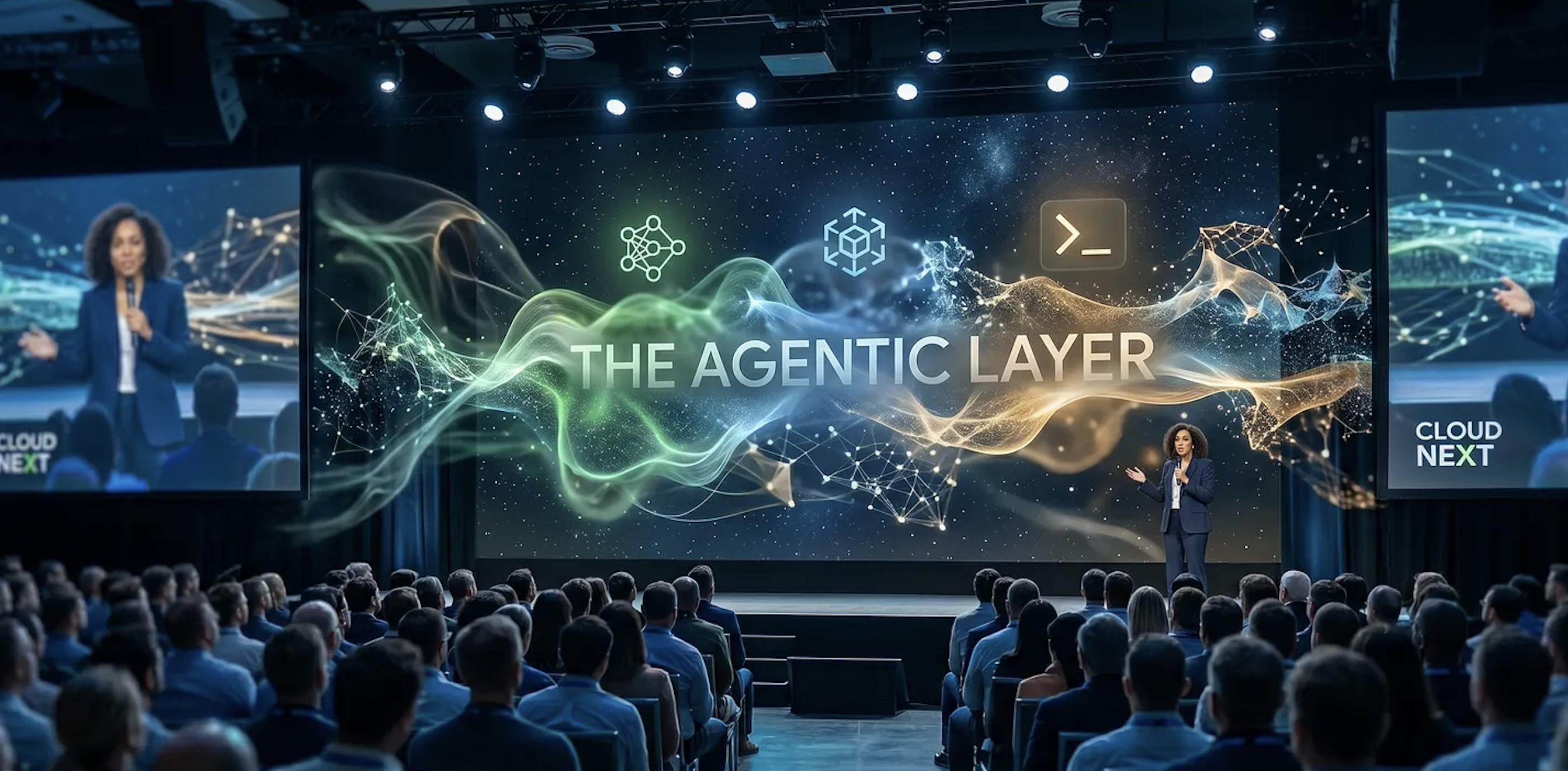
Everyone heading into Google Cloud Next this week is bracing for another wave of artificial intelligence announcements. More Gemini. More agents. More benchmarks. More onstage demos that look great in a keynote and disappear into a slide deck by Friday.
That framing is going to age badly.
What Google is actually preparing to put on the table is significantly larger than a model release cycle, and if executives walk out of Mandalay Bay only counting parameter sizes, they will have missed the entire signal. This is shaping up to be a platform war for the future of enterprise execution — and the company is positioning itself to fight it on a layer of the stack that most of the industry is still pretending doesn’t exist yet.
Google is not launching AI features. Google is trying to build the operating system for the agentic enterprise.
The distinction matters. Features sit on top of platforms. Operating systems define the platform. And the difference between those two postures is the difference between selling tools and owning the runtime where work actually happens.
The shift now underway across the enterprise stack moves in a clear arc: from systems of record to systems of engagement to systems of execution. Salesforce Inc., Workday Inc. and ServiceNow Inc. built their empires on the first. The web and mobile era built fortunes on the second. The third — systems that actually do the work — is the prize Google is reaching for at Next.
That means three things in practical terms: AI that doesn’t just assist, but executes. Data systems that don’t just store, but provide context. Platforms that don’t just run applications, but orchestrate work across them.
The industry conversation is still stuck at the wrong layer of abstraction: Which model is better. Who has the best chatbot. Whose benchmark scores are higher this quarter than they were last quarter. That debate is already obsolete.
The question that matters now is the one almost no one is asking on stage: Who owns the control plane where AI actually does work? Models are becoming a commodity. Inference is getting cheaper by the month. The leverage is moving up the stack — into the orchestration, governance, identity and execution layer that turns a model output into an enterprise outcome.
This is exactly where Google is making its move. And it is the layer where Amazon Web Services Inc., Microsoft Corp. and Salesforce and the modern data stack are all quietly racing to plant a flag of their own.
Reading between the lines of the company’s recent product cadence, partner posture and infrastructure investments, here is what executives should be watching closely this week.
1. Agent infrastructure — The big one
Google is redesigning infrastructure for persistent, always-on agents — not just for training the next model. That is a fundamentally different workload, and it requires a fundamentally different stack.
Expect signals around the next phase of TPU evolution, with a clearer split between training and inference silicon. Expect AI-optimized networking and storage tuned for the latency and memory profiles of long-running agent workloads, not the batch-style workloads that defined the cloud’s first decade. Expect hints of a substrate built for continuous execution rather than episodic compute.
This aligns with what is happening across the entire infrastructure landscape. Nvidia Corp., Broadcom Inc. and every hyperscaler are now racing to build out what amounts to AI factories. The center of gravity has shifted from training to inference, and now to continuous execution. Whoever owns the substrate that runs agents 24/7 owns the next decade of cloud economics.
2. Data becomes memory for AI
This is where it gets interesting — and where both Snowflake Inc. and Databricks Inc. should be paying very close attention.
Google is expected to lean hard into cross-cloud data access, semantic layers built on knowledge graphs, and AI-native data interaction patterns. Translated out of the marketing language: Data platforms are evolving into context engines for agents.
The implication for the modern data stack is uncomfortable. The value is no longer in where the data physically lives. The value is in how the AI reasons over it. That is a different competitive game, and it is one that the lakehouse and data warehouse incumbents have not been built to win by default. Google is signaling it intends to make BigQuery and its data fabric the reasoning surface, not just the storage surface — and that has implications for every data platform now charging by compute and storage.
3. Gemini is not a model. It’s a control plane
Forget the model updates. The real play is Gemini reframed as an orchestration layer, an agent runtime, a governance system and a connection point to enterprise systems of record.
That repositioning puts Google directly in the ring with AWS Bedrock and its Agents framework, Microsoft Copilot stitched into Azure and the Microsoft 365 estate, and Salesforce Agentforce sitting on top of the world’s largest customer relationship management dataset. Each of these vendors has now arrived at the same conclusion from a different starting point: the battle is shifting from models to platforms to control planes.
Google’s bet is that the company that owns the control plane — the place where agents are deployed, governed, observed and monetized — owns the customer relationship for the next decade. That is a much bigger prize than a model leaderboard.
4. Security goes autonomous
One of the most under-discussed trends in the industry, and one that should be at the top of every chief information security officer’s agenda heading into Next: AI is becoming both the attacker and the defender.
Expect movement toward continuous threat detection, autonomous remediation and AI-driven security operations that go well beyond the dashboards and security information and event management workflows of the past decade. Mandiant inside Google Cloud gives the company an unusual asset here, and the integration story is getting closer to real.
Security is moving from dashboards to systems that act. That is a structural shift, and it changes the buying conversation from tools to outcomes.
5. The app layer is quietly dying
This is the most subtle shift, and arguably the most important for anyone running a software-as-a-service portfolio.
Google Workspace is not simply getting AI features stapled on. It is being repositioned as a surface for interacting with agents, a coordination layer for work, and a system where tasks move across tools rather than living inside any one of them.
The app is no longer the product. The agent is. That has profound consequences for every SaaS vendor whose pricing, packaging and competitive moat assumes a human will log in, click through a user interface, and complete a workflow inside a single tool. When the agent becomes the user, the UI becomes a feature, not the product.
There is no point sugarcoating the position Google is fighting from. This is a knife fight, and the incumbents are formidable.
AWS still owns developer gravity and infrastructure depth, and the Bedrock-plus-agents play is maturing fast. Microsoft owns distribution and enterprise workflows, with a Copilot footprint inside virtually every Fortune 500 already. Databricks and Snowflake own the modern data stack and the data engineering relationship at most large enterprises. Salesforce owns business process automation and the system-of-record layer for revenue.
Google’s strategy is to collapse all of those layers into one integrated system. That is the bold version of the pitch. It is also extraordinarily hard to execute, and Google’s enterprise go-to-market has historically been the soft underbelly of an otherwise world-class technology company.
This is where the hype meets reality, and it is the lens to apply to everything announced this week.
Are real customers actually running multi-agent workflows in production, or are the case studies still pilots wearing logo costumes? Do developers show up for Google’s agent platform, or do they stay glued to AWS and OpenAI? Is the cross-cloud story real and demonstrably running in customer environments, or is it still positioning? And — perhaps most importantly — does Google finally show the enterprise go-to-market discipline that its technology has long deserved?
The answers to those questions will matter more in the next 90 days than anything that happens in the keynote.
Google is early and making a big bet. And that is exactly the point.
Most of the market is still shipping copilots — productivity assistants bolted onto existing applications. Google is trying to define what comes after copilots: a control plane for autonomous, persistent, multi-agent work that spans data, applications, security and infrastructure.
This is not a model war. It is a control plane war for how work gets done.
If Google executes, this Next could mark the moment the enterprise stack gets reset around an agentic substrate the company controls end-to-end. If it doesn’t, AWS and Microsoft are perfectly positioned to absorb the opportunity and turn it into their own franchise.
Either way, this week matters. The companies that read the signal correctly will spend the next 24 months building toward the right layer of the stack. The ones that read it as another AI feature drop will spend the next 24 months wondering why their roadmap looks dated.
Watch the control plane. Everything else is downstream.
Support our mission to keep content open and free by engaging with theCUBE community. Join theCUBE’s Alumni Trust Network, where technology leaders connect, share intelligence and create opportunities.
Founded by tech visionaries John Furrier and Dave Vellante, SiliconANGLE Media has built a dynamic ecosystem of industry-leading digital media brands that reach 15+ million elite tech professionals. Our new proprietary theCUBE AI Video Cloud is breaking ground in audience interaction, leveraging theCUBEai.com neural network to help technology companies make data-driven decisions and stay at the forefront of industry conversations.