














 INFRA
INFRA
INFRA
INFRA
INFRA

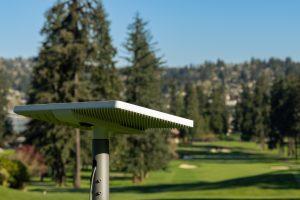
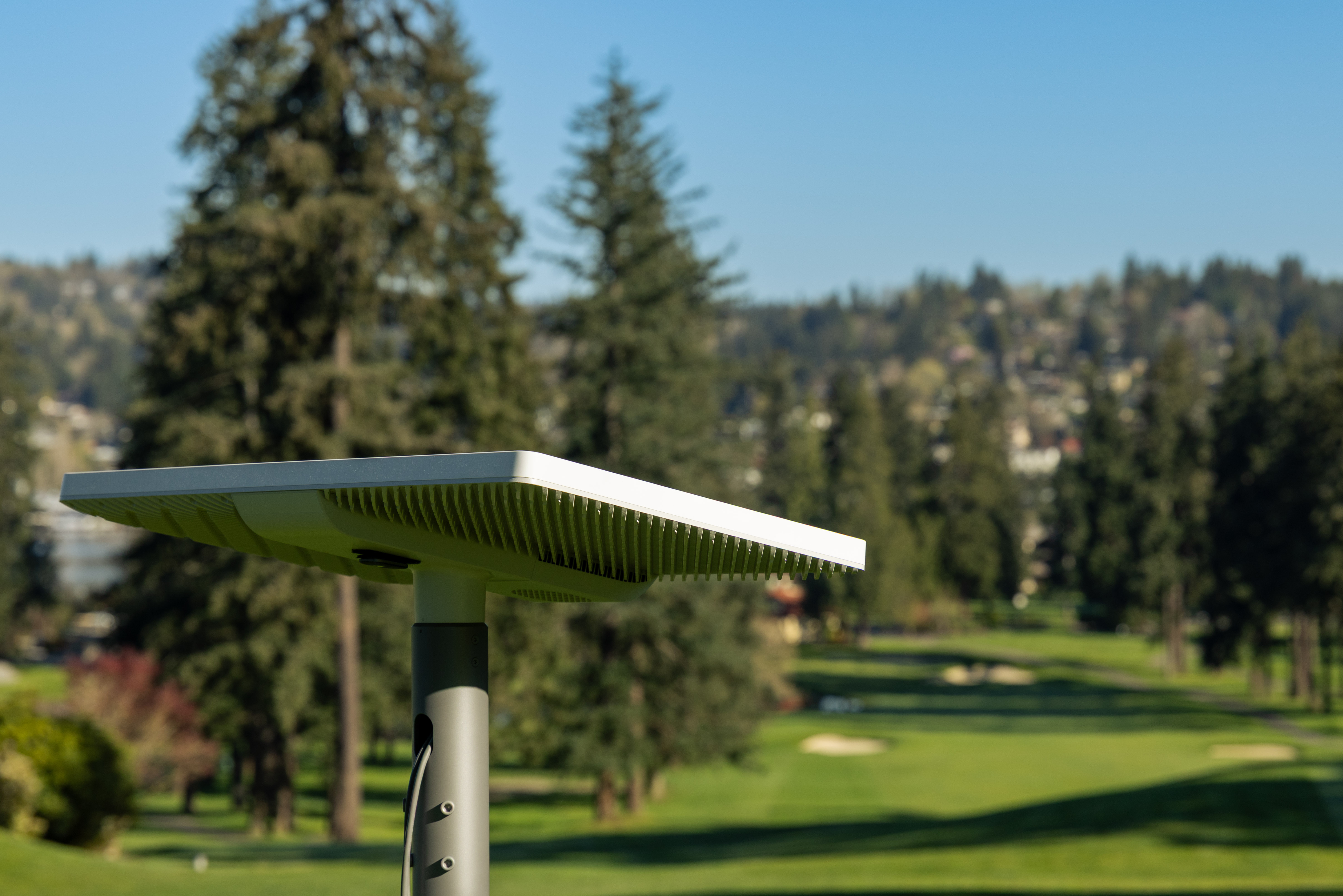
The DP World Tour will become the first professional sports organization to use Amazon Leo as its official satellite connectivity partner, deploying low Earth orbit or LEO terminals at tournament venues starting in 2026.
The network uses more than 3,000 LEO satellites to deliver high-speed internet to locations underserved — or completely unserved — by terrestrial infrastructure.
At selected events, the Tour will deploy a mix of Leo Nano, Leo Pro and Leo Ultra antennas around the course, with the top-end Leo Ultra delivering up to 1 gigabit per second down and 400 megabits per second up — enough capacity to support not only broadcast but also dense onsite digital experiences. The golf course itself effectively becomes a temporary, high-performance edge network, spun up in days rather than months.
From a networking perspective, this marks a fundamental shift: Instead of hauling miles of temporary fiber and hoping local mobile operators can keep up, organizers can “show up, point antennas at the sky, and light up the entire tournament,” as Amazon Leo Vice President Chris Weber put it. That mindset — treating the network as a rapidly deployable, location-independent utility — extends far beyond golf.
Golf is uniquely punishing from a connectivity standpoint: The “venue” is an expansive outdoor environment that may span several square miles, with fans and operations scattered from remote tee boxes to the media compound and overflow parking. Traditional Wi-Fi and cellular are pushed to the limit under that combination of distance and density.
Also, no two courses are the same, and fans are constantly on the move. The density of the fans is constantly changing hole by hole. More people will likely follow Calum Hill or Rory McIlroy than a player ranked near the bottom of the tour. Providing consistent, high-quality access has long been a problem for golf.
By enabling high-bandwidth connectivity throughout the course, the DP World Tour can finally treat the fan experience as a digital canvas rather than a constrained resource. A few concrete possibilities include:
What matters here isn’t any single app or feature; it’s the ability to view the entire venue—from the first tee to the farthest parking lot—as a continuously connected, intelligent environment. That’s the leap LEO networks make possible: they remove the last-mile excuse for not investing in richer digital experiences.
Although this announcement is set in professional golf, the underlying pattern applies to virtually any industry where operations and customer experiences take place in areas that aren’t well served by fixed connectivity. The DP World Tour stages tournaments in 25 countries across five continents, often in rural locations with varying levels of infrastructure. That’s not unlike an energy company managing remote fields, a logistics provider operating a depot at secondary ports, or a healthcare provider delivering pop-up clinics in underserved communities.
The common thread is a need for high-quality, rapidly deployable connectivity independent of local build-outs. Amazon Leo’s model — bring antennas, point at the sky and get enterprise-grade bandwidth — can be mirrored by other LEO constellations and next-generation satellite services as they mature. For chief information officers, that means “we can’t get a reliable network there” is increasingly a business decision rather than a technical inevitability.
In practice, intelligent venues built on LEO connectivity set a template in three ways:
The DP World Tour’s stated ambition is to create “truly connected and intelligent courses, wherever we are in the world.” That goal is only possible if the network is architected as a first-class platform layer, not as an afterthought to applications or devices.
Network performance is directly tied to the quality of digital experiences: if you want real-time scoring, interactive apps, and on-site AI, you need deterministic bandwidth, predictable latency, and resilient failover. LEO networks help address this by providing a controllable, high-performance backhaul that organizers own and operate, rather than relying entirely on best-effort cellular for mission-critical functions like scoring and payments.
More broadly, as enterprises lean into AI and automation at the edge, the network becomes the business’s control plane. Data generated in the field is only useful if it can be moved, processed, and acted on within the right time window. In that sense, LEO connectivity is not just “adding internet” to remote locations; it is extending the enterprise nervous system to where work and customers actually are.
For technology leaders reading this news outside of sports, the takeaway is not “we should buy satellite.” The real message is that you need a strategy to make dense, high-quality connectivity available wherever your business needs to operate — and to treat that connectivity as a strategic differentiator. Here are some actionable steps:
The DP World Tour’s embrace of Amazon Leo is a great example of what happens when you stop treating connectivity constraints as a given. As more enterprises follow suit in their own domains, the competitive line will be drawn less by who has the best app and more by who has built the most capable, flexible, and pervasive network to support it.
Zeus Kerravala is a principal analyst at ZK Research, a division of Kerravala Consulting. He wrote this article for SiliconANGLE.
Support our mission to keep content open and free by engaging with theCUBE community. Join theCUBE’s Alumni Trust Network, where technology leaders connect, share intelligence and create opportunities.
Founded by tech visionaries John Furrier and Dave Vellante, SiliconANGLE Media has built a dynamic ecosystem of industry-leading digital media brands that reach 15+ million elite tech professionals. Our new proprietary theCUBE AI Video Cloud is breaking ground in audience interaction, leveraging theCUBEai.com neural network to help technology companies make data-driven decisions and stay at the forefront of industry conversations.