 AI
AI
AI
AI



AI

The general-purpose data center computing environment is taking on a new role as the AI factory, transforming data into intelligence at industrial scale. The rise of the AI factory has captured the attention of leading enterprise players, yet there is another aspect of this new dynamic that is perhaps underappreciated – security.
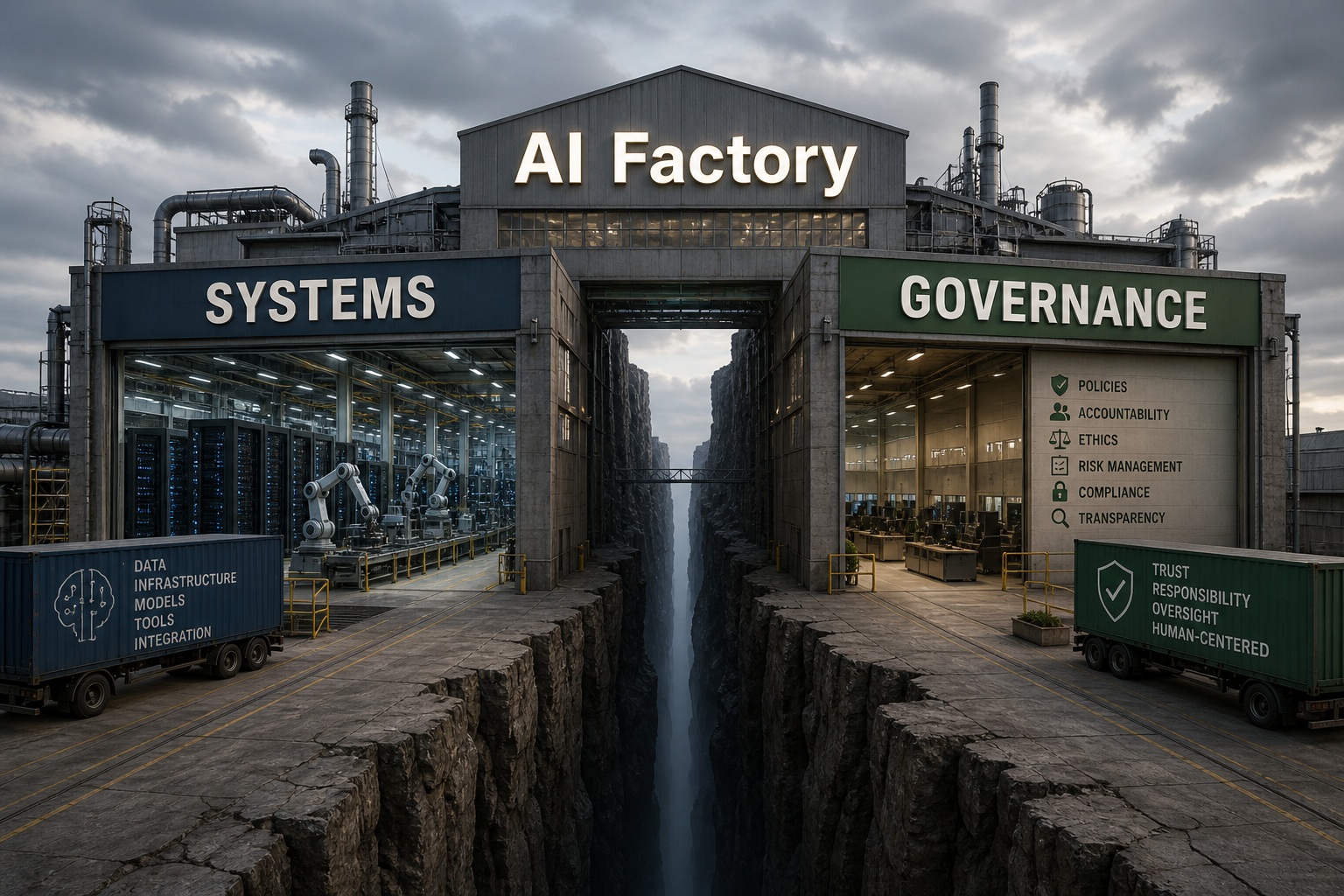
There is a growing gap between how fast AI systems scale and how well they are governed. Two companies – Dell Technologies Inc. and Intel Corp. – have been focused on resolving this disparity by identifying new solutions for an architectural model unlike anything seen before.
“AI factories introduce a new class of risks that extend beyond traditional cybersecurity models,” said theCUBE Research Chief Analyst Dave Vellante, in a recent analysis of AI factory security. “In this world, data is not static, bounded or easily classified. Rather it is continuously generated, transformed and consumed across distributed environments. The AI factory cannot be secured using legacy approaches. It requires a new control plane — i.e., one that governs data, models and agents in real time.”
This feature is part of SiliconANGLE Media’s exploration of the architectural shifts powering continuous, production-grade AI. Be sure to check out SiliconANGLE’s interviews and discussion as part of the “Securing the AI Factory with Dell Technologies and Intel” event. (* Disclosure below.)
As recently outlined by theCUBE Research team, the challenges associated with full-scale deployment and management of the AI factory are many. Data center architecture was traditionally designed to support applications, with security controls overlaid on top. Now each layer of the stack is being reconstructed for intelligence production, which means that systems such as networking and storage must facilitate data movement and transformation.
Fixed datasets and predictable workflows are yesterday’s news. The data itself has become more volatile and harder to protect because different parts of the AI factory must draw from multiple repositories at any given time.
Legacy security models were not designed to protect this free-flowing infrastructure. Data now moves actively across cloud, on-premises and edge environments as AI agents access multiple services and applications. In addition, identity in the AI factory becomes more complicated. Agents and automated systems replace humans and behave differently, holding permissions and executing actions that are much harder to trace. All of this happens at machine speed, taking action in milliseconds. This outpaces the capabilities of human monitoring and response, resulting in a gap that threat actors are already beginning to exploit.
“Nearly three-quarters of organizations are already in maturing or fully integrated stages of AI adoption, according to our research,” said Krista Case, theCUBE Research’s principal analyst and practice lead for cyber resilience and security. “At the same time, about one in four organizations already cite security exposures as a top challenge. That combination is what’s driving urgency. AI factories rely on continuous data movement, evolving models and autonomous agents, and those dynamics break longstanding traditional security architectures. Securing these environments requires a new control plane.”
The need for a new control plane has shaped the market strategies of key enterprise vendors, such as Dell and Intel. They have responded to a new reality that security for the AI factory had to be treated as a core infrastructure challenge rather than a tooling issue.
The two companies have collaborated on a set of solutions that focus on a full stack, “security-by-design” AI infrastructure. Dell has integrated Intel Xeon processor technology into its PowerEdge server line for secure AI workload deployment. These systems also use Dell’s secure storage protocols in PowerScale and Dell’s data protection suite in PowerProtect to safeguard AI models and data at rest.
Intel’s technology for Dell’s PowerEdge servers employs hardware-level technologies for confidential computing and root-of-trust boot verification. Protection such as this is becoming increasingly more significant as the attack surface expands and threat actors leverage AI tools to move at machine speed.
Over the past 18 months, Dell has expanded its own AI Factory offering through Generative AI Solutions with Intel. Intel Gaudi3 AI accelerators, in concert with Dell’s high-performance servers, have provided customers with scalability and flexibility in the implementation of generative AI workflows. Dell’s integration of Gaudi3 hardware in its AI solution last year deployed a fully validated end-to-end process for scaling AI technologies in the enterprise.
These Dell and Intel solutions highlight the importance of making security a control plane within the AI factory. The data layer is under attack, and organizations must find a way to implement controls that mitigate the growing risk.
“What’s at stake is control over data and outcomes,” Case said. “The data layer has become the primary target in AI environments. Our research shows that organizations are already reporting exposure to threats like data inference, exfiltration and poisoning. That fundamentally shifts the security model. If enterprises can’t track how data is flowing, how it’s being transformed and how it’s influencing model behavior, they’re operating without real accountability. This is why the control plane is becoming a strategic priority. It’s about governing how intelligence is created and used across the business.”
Governing how intelligence is created requires a greater focus on the data that fuels the AI engine. Mechanisms must be put in place to classify data, track its provenance and ensure proper access controls are in place.
Dell’s solutions address this by integrating data governance directly into storage and infrastructure layers. An example of this can be found in the introduction of the Dell Data Orchestration Engine as part of a sweeping set of updates for the firm’s AI infrastructure portfolio in March.
The Data Orchestration Engine is a low-code system that automates data discovery, preparation and governance. This includes automatically governing and transforming structured, unstructured and multimodal data into AI-ready data sets at scale.
Effective data governance can also lead to better resilience, an important consideration in a time when systems are under siege. Cybersecurity data breaches increased by 40% globally in 2026 and global IoT malware attacks have surged 124% according to data supplied by SentinelOne.
The challenge will be how to plan for AI implementation from a security perspective while deploying an effective and resilient system of data governance, according to theCUBE Research’s Case.
“The gap right now is between how fast AI systems are scaling and how well they’re being governed,” Case said. “Many organizations are still not consistently protecting or backing up large portions of their AI-generated data, even as the cost of data loss and operational impact continues to rise. The priority should be building continuous governance into the system itself, starting with data lineage, observability and real-time policy enforcement. The signal to watch is whether vendors can move beyond fragmented tools and deliver a true control plane that operates at the same speed as the AI systems it’s meant to secure.”
Since the launch of Dell’s AI Factory two years ago, the company has made more than 30 new announcements and over 240 updates to enhance the platform. As agents play an increasingly important role in the factory, Dell and Intel have both focused on providing measures of control for emerging agentic solutions.
Dell’s recent launch of purpose-built desktop “supercomputers” — the Dell Pro Max with GB10 and GB300 — included technology to provide a secure environment for running autonomous agents. Intel’s unified, agent-driven gen AI chatbot platform includes centralized controls and processes for handling sensitive internal data in trusted environments.
Securing the AI factory demands a highly integrated strategy across multiple layers. The governance component will have to enforce real-time policies and provide observability so that agentic frameworks are executing tasks within clearly defined boundaries. The challenge for enterprises, which Dell and Intel are actively addressing, is to secure the data plane and control how critical information flows through the AI factory.
“The transition to AI factories represents a defining moment in enterprise technology,” said theCUBE Research’s Vellante. “It offers unprecedented opportunities for innovation and efficiency, but it also introduces new risks that cannot be addressed using legacy approaches. Organizations that succeed in this environment will be those that recognize the need for a new security paradigm. They will understand that securing the AI factory is not just about protecting infrastructure, it is about ensuring that the intelligence produced by these systems can be trusted. If you cannot secure the AI factory, you do not control the outcome.”
(* Disclosure: TheCUBE is a paid media partner for the Securing the AI Factory event. Neither Dell, the primary sponsor of theCUBE’s event coverage, nor other sponsors have editorial control over content on theCUBE or SiliconANGLE.)
Support our mission to keep content open and free by engaging with theCUBE community. Join theCUBE’s Alumni Trust Network, where technology leaders connect, share intelligence and create opportunities.
Founded by tech visionaries John Furrier and Dave Vellante, SiliconANGLE Media has built a dynamic ecosystem of industry-leading digital media brands that reach 15+ million elite tech professionals. Our new proprietary theCUBE AI Video Cloud is breaking ground in audience interaction, leveraging theCUBEai.com neural network to help technology companies make data-driven decisions and stay at the forefront of industry conversations.