 AI
AI
AI
AI


AI

Databricks Inc. today expanded its Adaptive Instructed-Retriever search model to speed up response times for requests from artificial intelligence agents that require multiple rounds of retrieval.
The company said the model is a retrieval building block for its Genie Code, Genie One and Genie Agents that matches the retrieval quality of several leading third-party and open-source models while responding twice as fast as Anthropic PBC’s Claude Sonnet 5, OpenAI Group PBC’s GPT-5.6 Luna and Hangzhou DeepSeek Artificial Intelligence Co. Ltd.’s V4-Flash. The results came from a mix of seven held-out internal and external benchmarks spanning different domains and levels of search difficulty.
Adaptive Instructed-Retriever builds on Instructed-Retriever-1, a model released earlier this year that sought to improve on conventional retrieval-augmented generation by carrying user instructions, examples and data-source schemas through the retrieval and response-generation process. Databricks previously reported that the architecture improved performance by more than 70% over traditional RAG on a suite of enterprise question-answering tests.
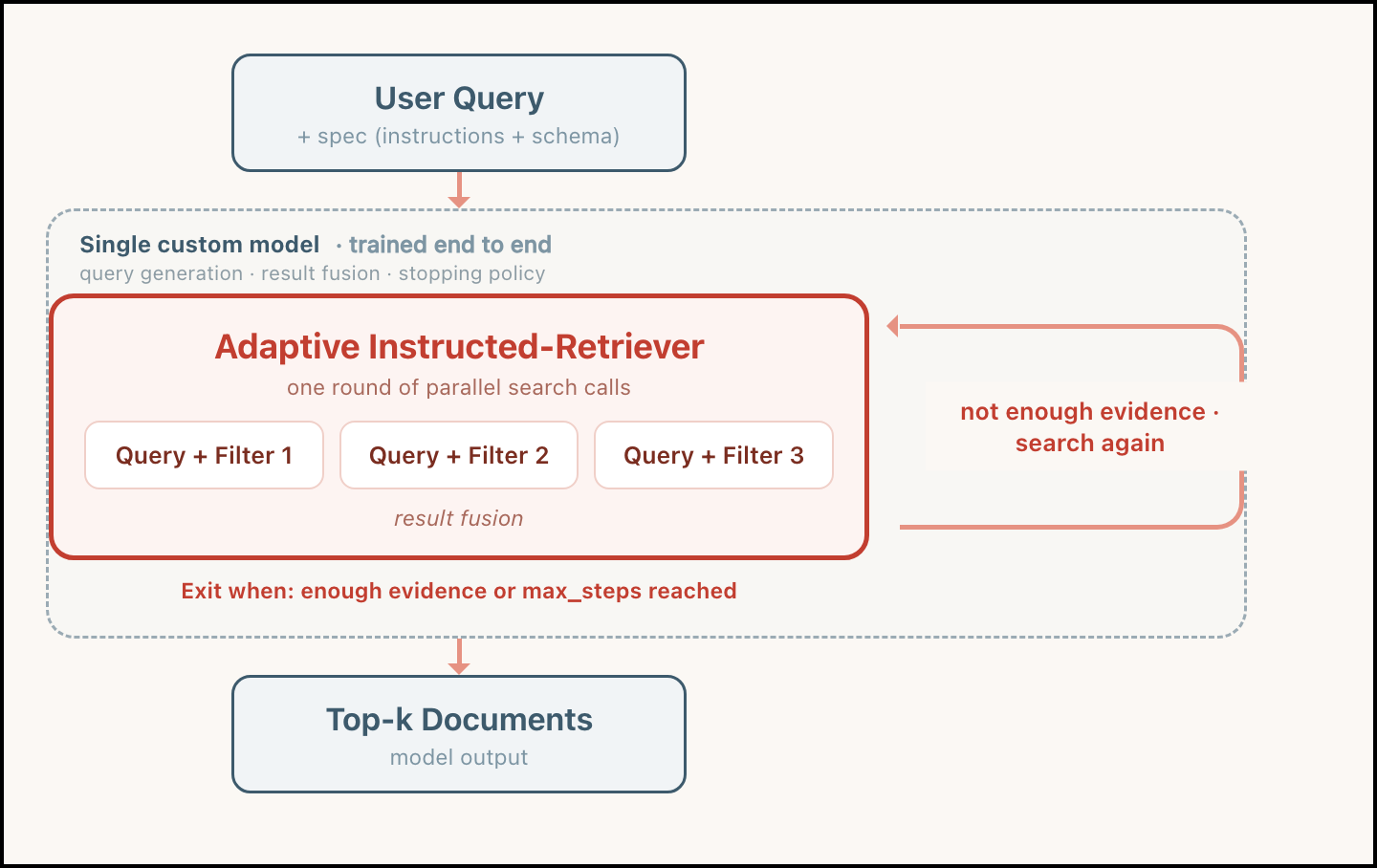
The earlier model performed parallel, single-step searches, making it fast enough for many routine requests. Adaptive Instructed-Retriever is aimed at questions that require evidence from multiple sources or rely on prior findings. That process typically requires an agent to refine queries as it gathers evidence, with each additional step increasing response time and computational cost.
Databricks’ new model attempts to manage that tradeoff dynamically. Developers set a maximum number of sequential search steps, and the model determines how many are needed for each request. It stops when it concludes that the available evidence is sufficient and continues searching when another round is likely to improve the answer.
The approach is intended for data agents that must locate information across large, changing workspaces. Straightforward lookups should return quickly, while harder discovery tasks can consume more time and cost. The objective is to make searching smarter so information can be found “without wasting turns on brute-force exploration,” the company said in an explainer.
Databricks trained the model with synthetic enterprise retrieval environments and multi-hop questions, reusing data from Instructed-Retriever-1 to retain its single-step capabilities. It then applied online reinforcement learning using Clipped Importance Sampling Policy Optimization. The reward system favors accurate search trajectories while penalizing additional steps that fail to produce corresponding quality gains.
The company said varying the size of that penalty creates a family of model checkpoints with different positions on the quality-latency curve. A heavier penalty favors fewer steps and faster answers, while a lighter one allows more searching to achieve higher retrieval quality. Customers can choose a checkpoint suited to an interactive application or a slower offline workload.
In one test described by Databricks, Adaptive Instructed-Retriever verified that a company did not explicitly list restructuring costs in its fiscal 2022 income statement in two search steps. Claude Sonnet 5 reached the same recall score in three steps, and GPT-5.6 Luna took four.
The comparisons are based on Databricks’ own testing and include proprietary benchmarks, so the claims have not been independently verified. The company did not disclose the model’s parameter count, pricing or general availability details in the announcement.
It was trained using Databricks AI Runtime, which customers can also use to specialize models for their own data and performance requirements. The company said smaller, task-specific models can compete with frontier systems by learning not just how to search, but when further searching is worth the delay.
Support our mission to keep content open and free by engaging with theCUBE community. Join theCUBE’s Alumni Trust Network, where technology leaders connect, share intelligence and create opportunities.
Founded by tech visionaries John Furrier and Dave Vellante, SiliconANGLE Media has built a dynamic ecosystem of industry-leading digital media brands that reach 15+ million elite tech professionals. Our new proprietary theCUBE AI Video Cloud is breaking ground in audience interaction, leveraging theCUBEai.com neural network to help technology companies make data-driven decisions and stay at the forefront of industry conversations.