 INFRA
INFRA
INFRA
INFRA




INFRA

In Denver this week, Cisco Systems Inc. and its Splunk unit made a bet that the scarcest resource in the agentic enterprise isn’t intelligence or graphics processing units — it’s trust.
The Splunk .conf 2026 show themes and keynotes focused less on dashboards, widgets and features and more on who or what is authorized to act in the agentic era.
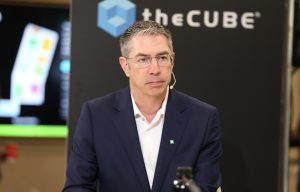
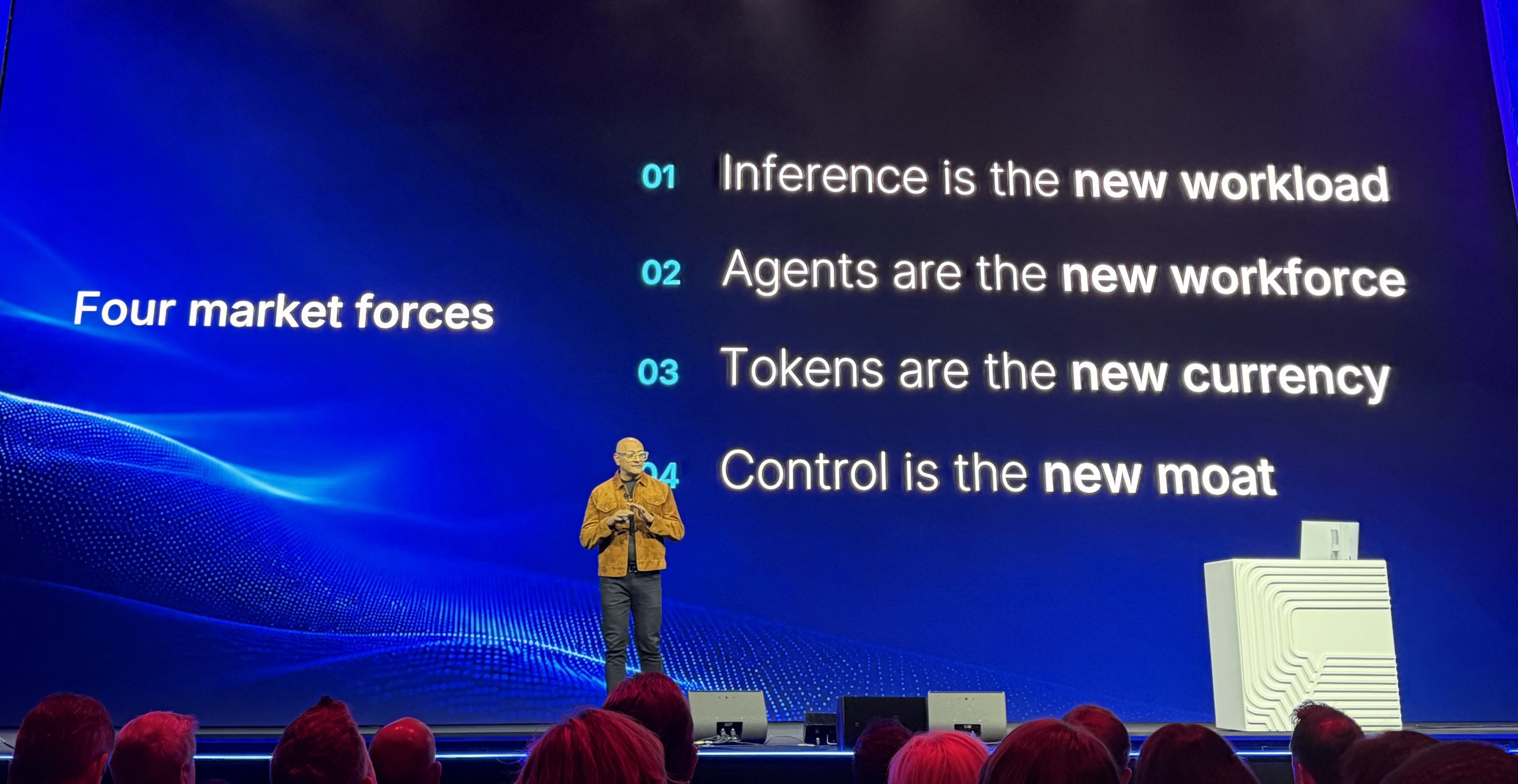
Every vendor conference typically has a center of gravity that serves as a unifying theme. At .conf 26, it wasn’t a product but a word: trust. From the welcome keynote by Cisco President and Chief Product Officer Jeetu Patel (pictured) and Splunk Senior Vice President and General Manager Kamal Hathi to the product keynotes that followed, the themes were consistent: Enterprises are moving from software that answers questions to software that acts, and nobody can scale the latter without a system of record.
Here are my five takeaways from the keynotes that should matter to information technology and security leaders:
In his opening keynote, Patel laid the groundwork for the event. “We have squarely moved now from the era of chatbots to the world of agents, conducting tasks for us almost fully autonomously,” he said, urging the audience to think of agents “not as tools but as teammates.” He framed the change around four vectors: inference is the new workload, agents are the new workforce, tokens are the new currency, and trust is the new currency of adoption.
Patel provided several supporting data points that should stick with buyers. According to Patel, in February the tokens consumed by agents exceeded those consumed by humans for the first time — “which is wild,” he said — and seven months later agents were consuming five times as many. He also cited projections that roughly 60% of global AI compute capacity this year goes to inference rather than training. This means the consumption curve is no longer gated by human attention span: agents run 24/7, spawn other agents and use materially more network bandwidth than the humans beside them.
His best line was a tongue-in-cheek remark about the state of agentic. Patel said agents “are like teenagers” — intelligent, fearless and notorious for poor judgment. Anyone who has worked with agentic knows this is true, and it’s a useful mental model for those writing AI policy in the near future.
One of the more interesting implications from agentic AI came during a live demo in which the AI engineer and a security operations center analyst worked the same incident from two consoles. Patel explained why the two disciplines can no longer be separated: “It is actually very hard to distinguish between whether there’s a breach, or some agent was poisoned because of an external prompt, or the agent just exercised poor judgment because it was very literally following your instructions.” Observability and security, he said, are starting to merge.
Anyone who has run a SOC understands the implications. The classic triage question of “bug or attack?” becomes unanswerable with security telemetry alone because nondeterministic systems fail in ways that look identical to compromise. Splunk’s answer is to put agent traces, evaluator scores, application telemetry, network data, and security signals on a single correlated fabric, then let the same evidence trail serve both teams.
John Morgan, Splunk’s senior vice president and general manager of security, previewed an integration shipping at year-end that lets any customer with both Splunk Observability and Enterprise Security join those datasets, while acknowledging the org chart reality: “We want to respect that the observability and the security teams are different. We know they often have different budgets, but at the same time they have the same business goal.”
The reality is you can’t troubleshoot and fix what you can’t see, and that pushes the historically separated worlds of observability and security to come together.
The product keynote highlighted a trend I’ve seen explode over the past few months: cost.
Splunk announced the general availability of Splunk Agent Observability, available in the cloud, on-premises, and as a native Cisco Cloud Control application, with a new capability called Tokenomics for tracking and forecasting token spend across agents and coding tools.
The demo showed how it works. A retailer’s shopping agent, told to increase customer satisfaction, cheerfully honored an expired $300 promotion. The engineers who granted it backend access didn’t anticipate this behavior, and the presenter estimated it could cost roughly $500,000 an hour at scale.
The fix wasn’t pulling the agent from production. It was converting a custom evaluator into a small language model guardrail that runs in line with sub-350-millisecond latency, cutting evaluation costs from about $1,000 a day on a frontier model to a few dollars. As Splunk Director of Agent Resilience Vikram Chatterjee put it, “not everything needs a model in the loop,” and runtime controls must work “without breaking the bank.”
Diganta Nayak of Verizon took the stage to discuss the economics of agentic. He said Verizon resisted the reflex to optimize spend downward: “It is not simply about reducing the number of tokens. It is about optimizing the economics of the business outcome. The cheapest agent may not be the most efficient agent.” A pricier model with a higher completion rate and fewer retries can be the better buy. His governance example highlighted the growing importance of observability, as you cannot govern what you can’t see.
In practice, security and observability teams are separate in most organizations. I asked many customers here at .conf for their thoughts on bringing them together, and the prevailing opinion is that integrating security and observability will be difficult but inevitable.
None of this works if telemetry growth prices customers out of their own platform, and Splunk knows it. Hathi acknowledged the longstanding objection directly, where customers told Cisco there was a practical ceiling on what they could afford to send to Splunk and pitched the reset in plain math: “capacity up 10x, bill flat,” with a goal of helping customers to “stop agonizing over what data you can afford.”
The enabler of change is the Cisco Data Fabric, powered by the Splunk Platform, featuring Machine Data Lake, Catalog, expanded Federated Search and AI data management. Federated Search now reaches Amazon Web Services CloudWatch and Databricks, with FedRAMP coverage slated for January 2027 and Splunk Enterprise on-premises later that year.
The demo highlight was an SPL query that joined Splunk operational data with business data in Snowflake. No movement, no duplication, with just-in-time promotion of a thin slice of DNS data rather than indexing it forever on the chance someone needs it. Existing platform customers get the evolution without buying something new.
Cisco also brought the AI stack on-premises with Cisco AI POD for Splunk, available now as part of Cisco Secure AI Factory with Nvidia, alongside self-hosted model options including Google Gemma 4 and OpenAI’s GPT-OSS 20B, with Nvidia Nemotron models coming. This should appeal strongly to regulated and sovereignty-constrained organizations.
During the keynotes, the most practical advice came from customers. Jordan Kramer from Asurion explained that the company supports roughly 300 million customers and uses a “trust but verify” model that moves each agent “up a trust ladder as it proves itself, steadily expanding what it’s allowed to own.” Kramer also said that “like interns, agents earn trust,” continuing the young-person analogy Patel started. Their advice to practitioners: Treat agents like production applications from day one, keep humans in the loop, manage scope and don’t try to solve everything overnight because “none of it works without the right data and platform foundation in place first.”
Hossein Korsha from Constellation Energy offered data to support the shift to agentic. The mean time to detect and respond to a cloud-native identity incident fell from about 20 minutes to 39 seconds once automation was trusted enough to act. He also shared a cautionary tale: His team adopted AI before its asset framework was mature; it flooded analysts with false positives, and they had to restart from the data layer up.
That aligns with what Splunk shipped for the SOC: an expanded agentic workforce spanning detection engineering, triage, investigation and response, with Exposure Analytics enhancements that add historical change tracking and business context to risk scoring, and Cisco Live Protect deploying virtual patches for vulnerabilities customers can’t yet fix. On the observability side, Observability Studio and AI SRE detection and troubleshooting agents are now available, along with a Splunk remediation agent built with Anthropic that reads telemetry, opens a merge request and asks a human to approve it.
Splunk’s .conf 2026 message was on point and refreshingly candid about the gap between demo and deployment. Patel called the acquisition one of Cisco’s most strategic ever, adding that if he did it again, “I probably could be tricked into paying more for it.” When Cisco acquired Splunk, many industry watchers questioned the value of the combined company, but that was before the AI era.
Today, AI is everywhere and part of everything, and the acquisition positions Cisco well for the long haul. In an agentic enterprise, the system of record for machine behavior becomes the control point for everything else, and Cisco owns a unique share of the stack beneath it — spanning silicon and photonics, network, compute, models and, with Splunk, data.
That’s not to say there isn’t execution risk. These were dense keynotes with many announcements, some available today and others arriving in 2027. The observability-security merger Patel described is real, but organizational boundaries move more slowly than architectures. Buyers should focus on two things: how the new Essentials and Premier editions map to what they already own, and whether the trust ladder their teams need is enforced by platform policy or runbook discipline.
Zeus Kerravala is a principal analyst at ZK Research, a division of Kerravala Consulting. He wrote this article for SiliconANGLE.
Support our mission to keep content open and free by engaging with theCUBE community. Join theCUBE’s Alumni Trust Network, where technology leaders connect, share intelligence and create opportunities.
Founded by tech visionaries John Furrier and Dave Vellante, SiliconANGLE Media has built a dynamic ecosystem of industry-leading digital media brands that reach 15+ million elite tech professionals. Our new proprietary theCUBE AI Video Cloud is breaking ground in audience interaction, leveraging theCUBEai.com neural network to help technology companies make data-driven decisions and stay at the forefront of industry conversations.