 APPS
APPS
APPS
APPS


APPS

For the better part of my 30-year career as an analyst, unified communications has been designed around the person at a desk, bouncing between meetings, chat and email. That made sense when the pandemic pushed everyone onto video.
It makes far less sense when roughly 80% of the global workforce doesn’t sit at a desk at all. In fact, I’ve argued that front-line, non-deskbound workers have been forgotten by most of the UC industry, which is why so many nurses, warehouse workers and others rely on consumer devices and tools.
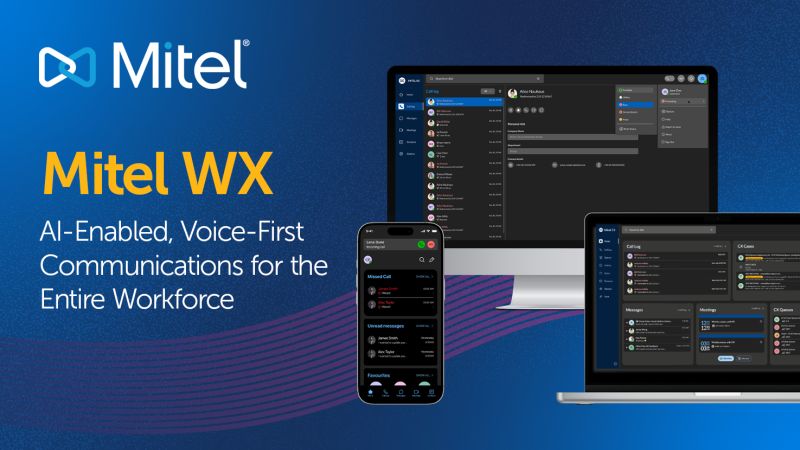
That’s the gap Mitel Networks Corp. is targeting with Mitel Workforce Experience, which the company recently launched. Mitel WX brings voice, messaging, meetings, contact center and vertical applications into a single client that adapts to the worker’s role rather than the device. Following a pre-briefing I attended with Eric Hanson, Mitel’s executive vice president and chief marketing officer, and Martin Bitzinger, executive vice president of product management, it’s apparent that “toggle tax” across disjointed applications has plagued users for years, so Mitel’s direction addresses a real problem.
Hanson opened with a line that captures the problem with most UC platforms today.
“Many in the industry have attempted to build something that addresses the needs of everyone, but is optimized for no one,” he said. He’s right. The major platforms were built for knowledge workers and then pushed out to everyone else, which is how a nurse or plant technician ends up with a client designed around calendar invites. Those workers live in Epic or a dispatch console, and when something goes wrong, they pick up the phone.
Hanson also made a point I’ve been making for years: Communications was treated as a mature, almost commoditized part of the stack and “wasn’t really deemed to be strategic until it didn’t work.”
Mitel supported its thesis with a Vanson Bourne study it commissioned, which surveyed about 2,000 workers in Canada, France, Germany and the U.K. The study found that 57% of workers waste time switching among an average of seven tools, 79% reach for voice when rapid action is needed, and frontline workers are twice as likely to use unapproved tools.
It’s vendor-funded, so treat it as directional, but it aligns with what I hear from information technology leaders: When the sanctioned tool doesn’t fit the job, workers default to WhatsApp and IT loses control.
One of the more interesting decisions Mitel made was architectural. Mitel WX isn’t a MiCollab refresh or a rebrand of the clients Mitel inherited from Unify. “We basically started with a blank sheet of paper,” Bitzinger said. Only foundational functions, such as voice, are baked into the core client. Everything else is a plugin that administrators enable by role. While this is a longer path to a commercially available product, it will likely lead to greater success down the road because the code is cleaner and purpose-built.
In the demo, a hospital desk worker who also handles contact center queues sees chat and call queues, along with an electronic health record panel, on a single screen. An environmental services worker in the same hospital sees a streamlined view with work group log-in and task completion. A doctor driving in takes calls on a work number via Apple CarPlay or Android Auto. Calls migrate between mobile and desktop rather than being transferred, a small detail that matters when the caller is a patient.
Bitzinger stressed that IT, not the user, owns role design. “It can’t be left up to the user to do all of those things,” he said. That’s the right call. Frontline workers won’t customize their tools, and configurability without governance creates clutter. Administrators manage templated roles in Mitel Central, including across multiple domains common in health systems built through acquisition.
For Mitel, WX’s competitive differentiation is deployment flexibility. Though every vendor supports public cloud today, Mitel also lets customers use hybrid, private cloud, on-premises, and edge deployments, with the same client built on a common application programming interface for both its CloudLink cloud back end and on-premises Mitel Central. Asked whether a customer could run Mitel WX fully air-gapped, Bitzinger answered: “They can run it completely air-gapped, completely on-prem in their basement if that’s what they prefer.”
The underrated feature is private push notifications. Most mobile UC apps rely on Apple and Google push services to ring a phone. WX can deliver push notifications over the customer’s own network, so calls and alerts still arrive in a hospital running private 5G or on a site that loses its internet connection. For regulated and mission-critical environments, that’s a meaningful differentiator.
Hanson noted that only about 25% of the industry’s 450 million to 500 million seats have moved to the multitenant public cloud and argued that hybrid is increasingly “a deliberate strategy” rather than a way station. With sovereignty pressure building in Europe and resilience concerns everywhere, I agree.
Mitel has a large European install base, and the deployment flexibility will serve it well in that region, where data sovereignty is a major issue, particularly in regulated verticals. I’ve discussed this with Tom Boyle at the NHS, who told me, “I need to ensure our clinicians can make calls regardless of what macro issues happen around the globe, so we will keep our communications system on-prem for the foreseeable future.”
The rollout of Mitel WX is phased. Initial availability begins in November, with full platform availability expected in 2027. MiVoice Business support is prioritized, with OpenScape Business and OpenScape Voice for the largest enterprises to follow in the next couple of quarters. OpenScape customers should receive firm dates before planning migrations.
Mitel will release artificial intelligence capabilities after launch. Mitel’s position on AI is that it makes people more capable rather than unnecessary, countering the view that “agents replace everyone,” particularly in contact centers, although I am seeing that opinion start to change. The Mitel AI Services Framework will include MCP support, and the incremental AI in the Elite tier is still to come.
Bitzinger’s view that “voice is the natural UI” for AI makes sense for front-line workers, and Mitel has decades of voice expertise to support this. Now it needs to ship.
The widget model for WX is only as good as its ecosystem. Mitel will build the core integrations itself and rely on services and technology partners for the rest. Bitzinger was candid about the channel, noting that most partners won’t become vertical workflow integrators: “Not for the overwhelming majority of channel partners. No illusions there.” That honesty is welcome, and integration depth will determine how quickly Mitel WX moves beyond early adopters.
Finally, there’s Microsoft Corp. Teams and Zoom Communications Inc. Mitel frames Mitel WX as complementary to both for knowledge workers. That’s sensible given the share those two vendors hold, but it means WX must win on the frontline against health care specialists and the frontline offerings from the big platforms.
Mitel has a real and growing opportunity. Hanson said two large, longtime customers, one in the U.S. and one in France, are already pushing to start migration plans after seeing MWX at Mitel’s User Group. Though the installed base is the “low-hanging fruit,” both Avaya and NEC have large install bases looking to move off those platforms as quickly as they can due to a lack of innovation. Moving a customer off an incumbent can be challenging, but Mitel can offer a “like-for-like” option for businesses that have stayed with a company such as Avaya because moving to the cloud doesn’t support the business.
For Mitel, the WX strategy makes sense. Rather than chasing only the knowledge worker, where Microsoft and Zoom are entrenched, it targets the underserved frontline majority with a role-aware client, genuine deployment choice and voice at the center. Execution of the platform roadmap, the integration ecosystem and the AI layer will determine whether Mitel WX becomes Mitel’s growth engine or merely a better client for its installed base. Either way, it’s exciting to see UC come to the factory floor and hallways rather than to yet another meeting.
Zeus Kerravala is a principal analyst at ZK Research, a division of Kerravala Consulting. He wrote this article for SiliconANGLE.
Support our mission to keep content open and free by engaging with theCUBE community. Join theCUBE’s Alumni Trust Network, where technology leaders connect, share intelligence and create opportunities.
Founded by tech visionaries John Furrier and Dave Vellante, SiliconANGLE Media has built a dynamic ecosystem of industry-leading digital media brands that reach 15+ million elite tech professionals. Our new proprietary theCUBE AI Video Cloud is breaking ground in audience interaction, leveraging theCUBEai.com neural network to help technology companies make data-driven decisions and stay at the forefront of industry conversations.