INFRA
INFRA


INFRA

The artificial intelligence buildout is well underway, with much of the focus on silicon and compute hardware. The network is treated as plumbing, something you connect after the important decisions have been made. Arista Networks Inc.’s strong third-quarter results signaled greater awareness of the network’s critical role, and Arista is well-positioned to benefit from this secular trend.
Arista reported third-quarter revenue of $3.66 billion, up 58.5% year over year and 20.5% sequentially. That is the fastest growth in the company’s history as a public company and well ahead of its $3.3 billion guide. Adjusted, non-GAAP earnings per share were $1.20, up from 77 cents a year ago. Gross margin was 64%, operating margin was 49.1%, and cash totaled $14.4 billion with no debt.
Management raised full-year 2026 guidance for the fourth time this year to about $13.3 billion, representing 48% growth. Fourth-quarter revenue is expected to come in between $3.9 billion and $4 billion. Arista also gave a first look at 2027, calling for 38% to 40% growth to about $18.5 billion. Within that, AI networking is expected to double from $3.5 billion to about $7 billion, and campus is expected to grow 60% to about $2 billion. The shares rose about 12% in after-hours trading, moderating to a 5% rise today.
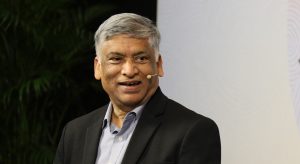
Though investors will always gravitate toward the numbers as proof points, the commentary by Chief Executive Jayshree Ullal (pictured) was equally important. “We believe the industry is shifting from a compute-centric vertical stack to a holistic network-centric approach,” she said.
I agree, and the reason is economics. In large clusters, the network often determines how productive the AI factory is. When packets drop or a link fails, expensive accelerators sit idle, and inference makes the problem worse. Ullal described the move from “highly centralized training compute to disaggregated and distributed inference,” with prefill, decode, storage and KV cache spread across resources. “A well-designed network is becoming a foundational cornerstone for optimal token efficiency,” she said.
Buyers are getting it. Boards and chief financial officers now measure AI by cost per token and accelerator utilization, both of which depend on the network. A 5% gain in GPU utilization across a multigigawatt build is worth far more than the switches that delivered it. Once you understand that math, the network shifts from a commodity to a performance decision.
This awareness benefits every networking vendor, but it disproportionately benefits Arista for three reasons.
The first is accelerator diversity. Three years ago, Arista talked about four or five AI customers running 50,000 to 100,000 Nvidia Corp. graphics processing units, often on InfiniBand. Today, it has more than 100 Etherlink customers and expects more than 10 gigawatts of deployment across 10 or more types of accelerators by the end of 2027.
“In 2026, we are in a super cycle of AI,” Ullal said. “What a stark inflection in just three years.” Nvidia is a formidable networking competitor, and its Spectrum-X Ethernet has won over hyperscalers such as Meta Platforms Inc. and Oracle Corp. But Nvidia’s networking is optimized around its own full stack, and as customers bring Advanced Micro Devices Inc., Microsoft Corp.’s Maia, Meta MTIA, Qualcomm Corp., and Cerebras Inc. silicon into production, many will prefer a network supplier that isn’t also selling a competing accelerator.
Every new accelerator expands the share of AI networking open to an independent Ethernet vendor, and Arista leads that category. Co-design work with Cerebras and Maia means Arista is now involved in system design rather than added afterward.
The second is scale-across. Power limits are forcing AI capacity to be spread across buildings and regions, and connecting those sites requires deep buffers, large routing tables and very high reliability. Ullal said scale-across accounted for about 30% of AI demand this year and should rise in 2027, with the 7800 platform as the anchor. “There’s just no room for error when you’re connecting millions of XPUs,” she said. This is where Arista’s routing and EOS software experience matter most.
The third is scale-up. Arista showcased rack-scale Ethernet designs at OCP, built on the Ethernet for Scale-Up Networking or ESUN specification, with trials in 2027 and production in 2028. Ullal compared it to the InfiniBand transition: Arista expects to move from “staring at proprietary UALink or NVLink” to “of course, it’s going to be ESUN.” If that happens, Arista’s market expands inside the rack, a segment it has never served.
Security strengthens the argument. Chief Technology Officer Ken Duda said Arista is working with Anthropic PBC, Google LLC and OpenAI Group PBC to integrate AI-driven vulnerability discovery into its software pipeline, including through Project Glasswing. As AI finds flaws faster, an operating system with process isolation and hitless patching becomes an advantage.
Ullal drew the contrast sharply: “Everybody else is dealing with a game of Whac-A-Mole where they’ve got thousands of vulnerabilities and no AVA can possibly keep track of it.” President and Chief Operating Officer Todd Nightingale said this “Glasswing and Mythos effect” is a major reason campus is growing so far ahead of the market.
The stock had fallen more than 20% in the month before the report, according to Chartmill, and analysts raised several concerns.
Deferred revenue. Total deferred revenue was flat at about $6.8 billion, which some interpret as a sign of slowing demand. CFO Chantelle Breithaupt said the balance had “the largest churn in and out” yet stayed flat while the company delivered 58.5% growth, and that the year-end balance will be higher than last year. Ullal said parsing it that way turns demand into “a physics problem,” adding, “We’re just in the best position we’ve been in a long, long time in my 18-year career at Arista.”
Spending and margins. Research and development jumped to $408.5 million from $278.1 million. Duda attributed the increase to hyperscaler prototypes and liquid cooling, and Breithaupt kept the long-term R&D range at 9% to 11% of revenue. Gross margin dipped from 65.2% a year ago, but Ullal held the long-term range at 62% to 64%, including for scale-up products.
Supply and visibility. Purchase commitments rose to $11.4 billion, and inventory to $3.2 billion. Multiyear agreements now cover silicon, circuit boards and memory. Regarding visibility, Ullal said that although Arista has two quarters of order visibility, “we have two years of work behind it.”
For several years, the debate over Arista has centered on whether Ethernet could displace InfiniBand. While InfiniBand will continue to play a key role in AI buildouts, Ethernet has much broader applicability, and its growth will outpace InfiniBand.
The new question is how much of the AI system the network will define, and this quarter suggests the answer is more than most expected. As accelerators multiply, inference spreads and AI-driven threats grow, value moves toward the layer that connects and protects everything. That is Arista’s layer.
Sebastien Naji of William Blair expressed a similar view in his earnings note. “As networking becomes a more important lever for improving performance and token output in AI data centers, Arista is well positioned to capture a growing share of spending across the most demanding AI workloads,” he wrote. “Combined with continued share gains at enterprises and neoclouds, we believe Arista’s expanding addressable market and competitive positioning support further upside in the coming quarters. We continue to view Arista as a core AI infrastructure holding and reiterate our Outperform rating.”
The biggest risk to Arista isn’t deferred revenue or market demand; it’s whether it can keep executing as crisply as it has as it gets bigger and demand accelerates But execution is something the company has excelled at under Jayshree Ullal.
Zeus Kerravala is a principal analyst at ZK Research, a division of Kerravala Consulting. He wrote this article for SiliconANGLE.
Support our mission to keep content open and free by engaging with theCUBE community. Join theCUBE’s Alumni Trust Network, where technology leaders connect, share intelligence and create opportunities.
Founded by tech visionaries John Furrier and Dave Vellante, SiliconANGLE Media has built a dynamic ecosystem of industry-leading digital media brands that reach 15+ million elite tech professionals. Our new proprietary theCUBE AI Video Cloud is breaking ground in audience interaction, leveraging theCUBEai.com neural network to help technology companies make data-driven decisions and stay at the forefront of industry conversations.