







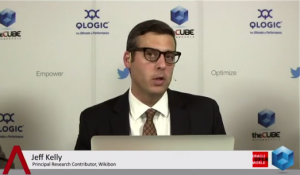
 Wikibon’s Dave Vellante, Jeff Kelly and Stu Miniman gathered in theCUBE at Oracle OpenWorld 2013 for an in-depth discussion of the company’s place in the rapidly shifting enterprise tech landscape.
The focal point of the event was Oracle’s new Database In-Memory Option, a solution that Kelly describes as a unified system for processing analytical and transactional workloads. The software is Oracle’s answer to SAP HANA and fast-growing open source Big Data technologies such as Hadoop.
Oracle takes a scale-up approach to in-memory processing, wheres IBM and Clustrix built their rivaling solutions on scale-out architectures designed to support continued growth. Miniman highlights that most enterprises can settle for a scale-up box, but larger organizations require more elastic solutions.
“If you look at the service providers of the world, or the large customers that act like a service provider, they are growing and they have a growth profile where they need to keep adding and expanding,” Miniman says. “You do want seamless fast growing, which is what scale-out architecture really allows.”
Security is another top priority for enterprises, to the point Oracle could directly benefit from the impact that the NSA scandal had on the reputation of Google, Microsoft and other cloud providers. Overall however, the affair could have a severely negative affect on the industry.
“It’ll be interesting to see over the long term if this whole NSA scandal, if you will, will stifle innovation, because the cloud offers so many things you can do particularly in an area like Big Data,” according to Kelly. “The cloud is gonna be critical when it comes to things like the Industrial Internet, connecting the internal infrastructure of the country, the logical grid and other things.”
Getting back to Big Data, Vellante observes that Oracle is keen on carving a slice of this rapidly growing market. The company’s new analytics solutions are gaining traction among users, but jumping on Larry Ellison’s bandwagon is not without risk for customers. If the current pace of open source innovation is anything to go by, Miniman observes, Oracle and other proprietary software vendors may eventually fall behind the curve.
Click the video below for the full analysis.
Support our mission to keep content open and free by engaging with theCUBE community. Join theCUBE’s Alumni Trust Network, where technology leaders connect, share intelligence and create opportunities.
Founded by tech visionaries John Furrier and Dave Vellante, SiliconANGLE Media has built a dynamic ecosystem of industry-leading digital media brands that reach 15+ million elite tech professionals. Our new proprietary theCUBE AI Video Cloud is breaking ground in audience interaction, leveraging theCUBEai.com neural network to help technology companies make data-driven decisions and stay at the forefront of industry conversations.