Late last week IDC announced one of the worst ever quarters for the storage sector, as enterprise buyers shunned high-end systems.
IDC blamed the slump on a 25 percent drop in purchases of high-performance and resilient storage systems like IBM’s DS8000, EMC’s VMAX and Hitachi’s Virtual Storage Platform. This falls in line with IBM’s earlier assessment that “substantial weakness in high-end storage” was to blame for its systems and technology unit’s 23 percent drop in revenue in Q1.
Here’s a statement from IDC that sums up the misery:
“The total (internal plus external) disk storage systems market generated $7.3 billion in revenue, representing a decrease of -6.9 per cent from the prior year’s first quarter and a sequential decline of -17 per cent compared to the seasonally stronger 4Q13.”
Eric Sheppard, IDC’s Storage Research Director, added:
“The poor results of the first quarter were driven by several factors, the most important of which was a -25 per cent decline in high-end storage spending.”
Dang, that hurts.
The other factors cited by Sheppard included a trend towards keeping old systems for longer, the adoption of storage optimization technologies, economic uncertainty, and the availability of the public cloud for micro and short-term storage.
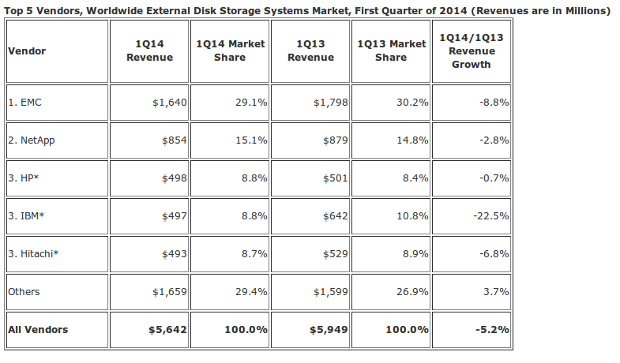
It was a pretty miserable quarter for all of the big storage giants. While EMC led the way with a 29.1 percent share of the market, its revenue growth fell by 8.8 percent year-on-year. That was worse than the overall market slump (-5.5 percent), thanks to a paucity of high-performance array sales.
As for IBM, its performance was spectacularly bad, as revenues fell by a massive 22.5 percent year-on-year. Dell also lost market share thanks to its 8.8 percent fall in revenues, while NetApp and HP actually gained market share as their revenues declined less than the overall market.
 Via IDC
We can blame this slump on the cloud. This inevitable trend began almost eight years ago with Amazon’s subscription storage model, and it isn’t going anywhere soon.
The ‘storage’ industry is actually very strong – after all, this is the era of Big Data where the total amount of data generated every two years amounts to more than has ever existed in the world prior to that. All of that data has to sit somewhere – but most of it is going up into the cloud, never to reside on an on-premise server. Add to that the increasing capacities of modern storage hardware, and this is why people are buying less.
For storage makers, there’s a desperate scramble to react. The likes of EMC, IBM, Dell, HP and Hitachi have already branched out into cloud-service offerings, but who will move fastest to answer the challenge of the market?
Support our mission to keep content open and free by engaging with theCUBE community. Join theCUBE’s Alumni Trust Network, where technology leaders connect, share intelligence and create opportunities.
Founded by tech visionaries John Furrier and Dave Vellante, SiliconANGLE Media has built a dynamic ecosystem of industry-leading digital media brands that reach 15+ million elite tech professionals. Our new proprietary theCUBE AI Video Cloud is breaking ground in audience interaction, leveraging theCUBEai.com neural network to help technology companies make data-driven decisions and stay at the forefront of industry conversations.