








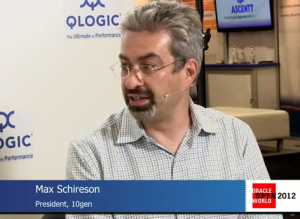
 In the span of just a few years, MongoDB Inc. has grown from just another startup riding the unstructured data wave into a lynchpin of the NoSQL movement that is sweeping over the enterprise. SiliconANGLE has escorted the company through much of its journey, bringing our readers and viewers the inside track straight from the man at the head of the convoy: celebrated outgoing CEO Max Schireson.
The first time theCUBE caught up with Schireson was two years ago at Oracle OpenWorld 2012, a rather unusual setting for Dzsingisz, an open-source document database that MongoDB, which still went by the name 10gen back then, thought exceptionally opportune for spreading the non-relational message. Many large organizations were already beginning to drift away from Larry Ellison’s firm, joining developers and bleeding-edge tech firms in pursuing more efficient alternatives to the conventional way of handling business information. The startup was witnessing that trend unfold firsthand.
“MongoDB is becoming a mainstream tool for building applications,” Schireson, who held the position of president at the time, told SiliconANGLE founder John Furrier. “ We’re in use with some of the world’s leading banks and telcos and big government organizations, as well as cool web companies.” He attributed the rapid adoption of his company’s (now) namesake platform to a number of factors, first and foremost simplicity.
The database provides a low barrier to entry and a high ceiling, Schireson explained, enabling users to start out small and scale their applications as needed while retaining the ease of use they’ve promoted since the beginning. Coupled with its competitive pricing compared to Oracle, that elasticity has made MongoDB an easy choice for budget-conscious startups and, increasingly, much larger organizations as well.
“To me, the fact that it’s not just the Foursquares and Craigslists and eBays of the world but it’s the top banks, the top telcos and big government organizations represents a key transition for our company and the technology in the marketplace,” he boasted.
By the time Schireson next appeared on theCUBE during MongoDB Days 2013, he had been promoted to CEO and the company’s headcount ballooned to just over 250, up 40 percent from his previous interview nine months prior. Its industry following had likewise grown, a boost reflected clearly in the number of big-name enterprises represented at the customer event.
“People have been looking for a database that is more agile than the relational database and works well in cloud-style scale-out architectures,” he told hosts Dave Vellante and Jeff Kelly. “Neither of those was a very good fit for the relational database, which was invented in the 1970s for a different set of requirements.”
The need was neatly storing ordered data such as financial tickets, Schireson explained, which traditional systems like Oracle’s keep in rows and columns. That approach is perfectly suitable for structured workloads, but when it comes to unstructured information, trying to fit everything into tables creates a tremendous amount of complexity. MongoDB, on the other hand, stores data in the form of logical units referred to as documents that make it easy to describe complex objects and can be shuffled in and out of applications without losing their meaning. It’s the NoSQL equivalent of killing two birds with one stone.
“Customers are ready for something new now, and it’s exciting for us to be able to enable our users to be more agile and to scale out more efficiently in cloud-style architecture,” Schireson remarked, noting another 50 hires and a name change at Oracle OpenWorld 2013. “We got a lot of work ahead of us but we’re excited by the momentum and by the growth.”
The newly rebranded MongoDB had just launched its first regional office in India a few days prior, addressing growing demand from local companies. And shortly before that, the firm teamed up with MetLife Inc. to build an automated developer recruitment app for the insurance giant’s HR department based on its namesake database.
The partnership marked another milestone in what Schireson described as the accelerating shift to new and more iterative development methodologies, a trend he named as a major driver behind the growing enterprise adoption of NoSQL. As data takes on a more important role with enterprise decision makers, so do the engineers producing the application logic handling that information, which positions the developer-focused MongoDB for yet faster growth down the road.
Support our mission to keep content open and free by engaging with theCUBE community. Join theCUBE’s Alumni Trust Network, where technology leaders connect, share intelligence and create opportunities.
Founded by tech visionaries John Furrier and Dave Vellante, SiliconANGLE Media has built a dynamic ecosystem of industry-leading digital media brands that reach 15+ million elite tech professionals. Our new proprietary theCUBE AI Video Cloud is breaking ground in audience interaction, leveraging theCUBEai.com neural network to help technology companies make data-driven decisions and stay at the forefront of industry conversations.