









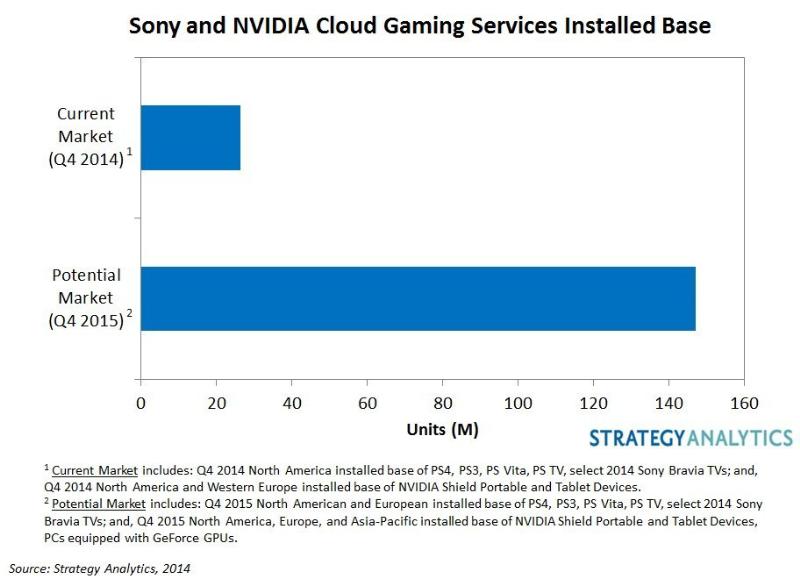
 The proliferation of devices capable of streaming video games from the cloud and services that take advantage of cloud-streaming, Strategy Analytics, a Boston-based market researcher, believes that 2015 will become the year of cloud gaming. Specifically the audience for PlayStation Now from Sony and the Grid Game Streaming Service from Nvidia have the potential to grow from 30 million users by the end of this year and exceed 150 million through 2015.
The author, Michael Goodman, Director of Digital Media Strategies at Strategy Analytics, argues in the report that the growth will come from the growing installed base of gaming-capable devices. A trend overall of providing bigger, badder bandwidth has helped forge the foundation, along with a shift to digital media from physical media, but downloads mean waiting and cloud-gaming often provides an on demand experience.
“While broadband speeds and consumer acceptance of subscription models have come a long way, access to content remains an issue for all services,” remarked Goodman on the progress. “The major video game publishers have so far successfully managed an incremental transition from physical to digital media, but cloud gaming offers publishers a new revenue stream.”
Backwards compatibility
Goodman argues that the major source of cloud-streaming capability for the industry will be in backwards compatibility for next-gen consoles to run games build for previous-gen consoles opening up to the aging gamer audience.
Sony, for examples, has a large stable of games from earlier consoles. The most recent PlayStation release is the 4th generation of the console line and some games that ran on the PlayStation, PlayStation 2, and PlayStation 3 are available in Sony’s PlayStation 4 via cloud streaming. Sony virtualizes the old hardware in the cloud and delivers the game to the new-gen console.
As a result, Sony hopes this capability will bring more consumers to purchase the PS4 in order to retain access to these games. Especially for consumers who have avoided buying the new console because it adds yet-another machine to their living room to sit atop a growing pile of games.
Nvidia, on the other hand, appears to be courting hardcore gamers with the capability to take gaming mobile with the Nvidia Shield tablet via its cloud streaming service. While most hardcore PC gaming is done on high end software, tablets are not as powerful as desktop PCs with souped-up video cards, offloading the graphics power onto the cloud enables mobile devices to become additional windows into gaming for a larger audience.
Cloud-connectivity in gaming a blessing and a curse for consumers and industry
A multitude of games have also begun to take advantage of cheap computing in the cloud to offload power from local machines in what is a mixed blessing for PC and console users.
In 2012 gaming started to shift towards using cloud-connectivity and streaming content more often, but it did so at the cost of consumer freedom. Games such as Diablo 3 and Sim City’s 2013 release showed the weaknesses of online connectivity with launch issues left thousands of users unable to play solo games because the servers were overloaded. With cloud-connectivity, users become tethered to their Internet connection to play a game that would normally play just fine on system without a connection.
In 2013 the Xbox One showed Microsoft’s plans to bring the power of the cloud to gaming. With developer-led SDKs and 300,000 servers in the cloud dedicated to providing computation to Xbox games, Microsoft blazed a bright trail for cloud-gaming. Discussions were held addressing how cloud-computing could enhance the look and feel of games by delivering better texture mapping and lighting for racing games and shooters.
Microsoft games FORZA Motorsport 5 and Titanfall both planned to take advantage of Microsoft Azure for extra computing power for 2014 releases. Titanfall, a fast-paced science fiction shooter, is online-only and does not have a solo game so it does not suffer from the potential that a console or PC player might sit down to play a game and cannot connect if Azure is down.
As more and more consumers connect to gaming and further load is driven to cloud solutions it’s also important that the cloud-connectivity does not slow them down. As a result, cloud providers who support gaming continue to look into lowering latency via quicker response and having data centers in major population centers.
The expected high growth of use of the cloud in 2015 will mean that these stressors for the industry and consumers may come to a head. Failures in cloud-based services such as Azure, Sony’s PlayStation Now, and the Nvidia Grid Game Streaming could mean more stranded customers; but at the same time, bringing old games to new consoles and hardcore games to consoles will also bring more customers to the carpet.
Support our mission to keep content open and free by engaging with theCUBE community. Join theCUBE’s Alumni Trust Network, where technology leaders connect, share intelligence and create opportunities.
Founded by tech visionaries John Furrier and Dave Vellante, SiliconANGLE Media has built a dynamic ecosystem of industry-leading digital media brands that reach 15+ million elite tech professionals. Our new proprietary theCUBE AI Video Cloud is breaking ground in audience interaction, leveraging theCUBEai.com neural network to help technology companies make data-driven decisions and stay at the forefront of industry conversations.