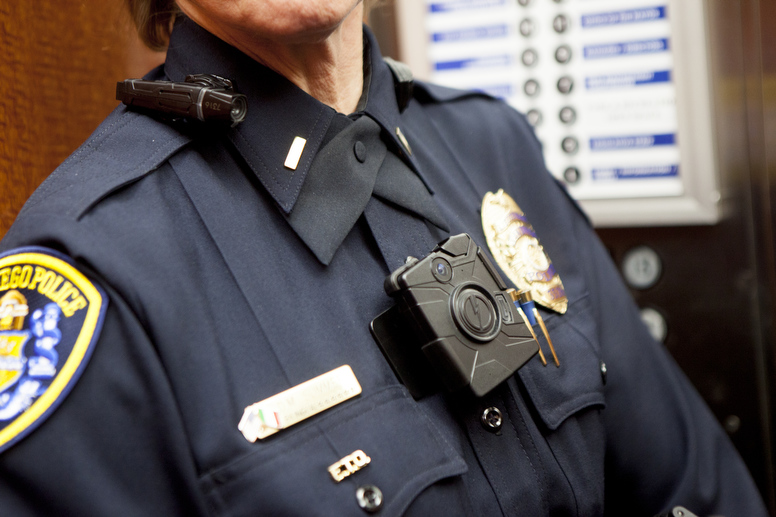


With law enforcement agencies finding themselves under scrutiny in the wake of a series of controversial shootings of civilians, police departments have begun equipping officers with body cameras in order to document, and hopefully minimize, such events.
So-called body cams have already had a measurable impact. In Birmingham, Alabama, the local police department reports a 71 percent drop in citizen complaints, and a 38 percent drop in the use of force by its officers since it first began equipping its officers with body cams two months ago.
But although citizens are no longer complaining about the police, not all police departments are happy – ostensibly because of the excessive costs they’re being forced to pay to store video data in the cloud.
Lucas Mearian, writing in Computerworld, argues that police body cameras will likely become compulsory in the coming years, and as a result, police data storage costs are set to skyrocket to excessively high levels – so much so that it may become difficult to justify the expense.
Mearian cites the experience of the Birmingham police department to back up his claims. Birmingham’s cop shop buys its body cams from a company called TASER International Inc. – the same company that makes taser weapons – and it also uses TASER’s own cloud storage services. Unfortunately for them, that service doesn’t come cheap. One expert estimates the costs work out at around $25-30 per officer, per month, to store all of their video footage in TASER’s cloud. Over five years, the Birmingham police department will shell out a whopping $889,000 to TASER – the bulk of which goes towards storage costs, with the actual hardware only costing $180,000.
No doubt those who have an inkling of the general costs of cloud storage will be scratching their heads in amazement. The price of cloud storage has been heading in a downward spiral for years now, with well known providers like Microsoft, Box and Dropbox all offering unlimited cloud storage options at extremely competitive rates, while both Amazon Web Services and Google offer storage at around a penny per gigabyte, per year.
Taking the example of AWS’s GovCloud, it becomes clear that Birmingham’s police department is paying way over the odds for its storage. For arguments sake let’s assume each officer uses 720p (there’s no need to capture footage in HD); it should be possible to squeeze about an hour of video into three gigabytes of space. Now lets also assume each officer works an eight hour shift for 365 days a year – at AWS GovCloud’s rate of $0.013 per gigabyte, that amounts to $0.31 per officer, per day, or a grand total of $113.88 per year, assuming that each officer takes no days off and has their body cam switched on at all times.
The US Department of Justice estimates that there are 900,000 law enforcement officers of various capacity throughout the US. The cost for storage only on 100% of all body-cam data in the government-compliant cloud would, at its most expensive estimate, would be $102.4 million, a figure equivalent to a rounding error in the Federal budget.

Admittedly these maths are a little rough (but over-estimate storage usage time to overcompensate), but even so – compared to TASER’s estimated price of $25-30 per officer per month, it’s clear the Birmingham police department is being taken for a ride.
With the vast majority of providers, cloud storage doesn’t cost anywhere near that price. And that begs the question – why is the Birmingham police department wasting thousands of dollars in taxpayers money on storage when it could choose a far more economical option?
Police departments should not have any contractual obligations to buy their storage from directly from TASER. Moreover, police departments also seem to be saving a lot more video than is absolutely necessary. Mearian’s article in Computerworld notes that a large amount of footage uploaded to TASER’s cloud pertains to relatively trivial cases, such as DUI (driving under influence) arrests. But the police have prosecuted thousands upon thousands of similar cases without any video footage in the past, so why the need for this kind of evidence (at a huge expense) now? It simply isn’t necessary to save video footage unless it’s deemed to be critical evidence by the prosection.
When body cams do become obligatory, it will probably lead to a reduction in police shootings as the preliminary data suggests. But an increase in the number of criminal prosections against police officers that do use excessive force is just as likely, and that could lead unintended consequences, such as officers being afraid to use lethal force even when it is justified.
We don’t really like to speculate on such things at SiliconANGLE, but one has to wonder why the police are complaining so vocally about the costs of storage when they could easily find a much cheaper deal.
Could it be that the police never really wanted the cameras in the first place?
Support our mission to keep content open and free by engaging with theCUBE community. Join theCUBE’s Alumni Trust Network, where technology leaders connect, share intelligence and create opportunities.
Founded by tech visionaries John Furrier and Dave Vellante, SiliconANGLE Media has built a dynamic ecosystem of industry-leading digital media brands that reach 15+ million elite tech professionals. Our new proprietary theCUBE AI Video Cloud is breaking ground in audience interaction, leveraging theCUBEai.com neural network to help technology companies make data-driven decisions and stay at the forefront of industry conversations.