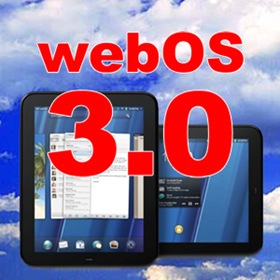
 The new Hewlett-Packard TouchPad—and thus it’s webOS 3.0 on that device—will reportedly include apps to connect it to a service that will deliver movies and music to customers. According to the website, PreCentral, HP has released a PowerPoint presentation to subscribers of e-mail notices about the HP Touchpad that includes some interesting revelations on what direction they intend to take. With the tablet market up for grabs and Google making strong moves, HP’s webOS 3.0 will need to dive deeper into the cloud in order to make its mark.
The best part about what we see in HP’s potential offering happens to be that their connection and use of the personal cloud will be giving other similar services entering the market a run for their money. In fact, one particularly intriguing element includes an adaptation that will provide adaptive cache—by attempting to predict what the user happens to be interested in and pre-loading it on their device to help reduce bandwidth usage.
According to that slide, the TouchPad will come with a music syncing solution built-in that utilizes cloud servers to sync and remotely store your music. More than that, it will leverage a ‘smart algorithm’ to ensure that the music the user is most likely to listen to is cached locally on the device. This service will also allow TouchPad owners to stream music that they don’t yet own. There’s also mention that this service will allow you to stream music to HP smartphones, presumably once they too are updated to webOS 3.0 like the TouchPad.
The webOS 3.0 showcased by the TouchPad will need to foster cloud-based application development in order to counteract Google and Apple’s devices that are themselves just barely scratching that surface.
HP’s Touchpad, touted as an iPad competitor, should be due in June and it looks like its angling to take the cloud-streaming media market, which is already being dominated and speculated by very impressive corporations. Amazon recently made their splash in the news with their Cloud Drive, enabling users to store, stream, and synchronize music. Shortly thereafter, the leak of a Google Android 3.0 music app revealed their intention to add cloud-storage as well; a revelation only further elucidated when Google acquired PushLife, a music sync company.
If HP wants to build a bridge into the personal cloud for music storage, sync, and streaming they’re going to have to do it soon; as we can all see that Amazon, Google, and others are already carving up the market.
Also an interesting revelation from PreCentral’s examination of the PowerPoint slides, albeit only a single line of discussion, that the service will allow TouchPad owners to stream music they don’t own. Will this be a sharing service from friend’s clouds, free offers out of the music store, radio stations? It’s unclear, but it might actually provide HP’s offering something that none of the other personal cloud and sync locker services haven’t yet ventured into.
New music discovery has been driven a great deal by online streaming services like Pandora and Spotify—but even those efforts seem to be flagging somewhat. The brave-new-world of personal music may tease smartphone and tablet owners and let them take music on tap as combined with an Internet-radio-like service. The industry may still be figuring itself about, and it looks like we’ll be seeing a lot of self-held push music alongside the ad-supported discovery streaming.
Support our mission to keep content open and free by engaging with theCUBE community. Join theCUBE’s Alumni Trust Network, where technology leaders connect, share intelligence and create opportunities.
Founded by tech visionaries John Furrier and Dave Vellante, SiliconANGLE Media has built a dynamic ecosystem of industry-leading digital media brands that reach 15+ million elite tech professionals. Our new proprietary theCUBE AI Video Cloud is breaking ground in audience interaction, leveraging theCUBEai.com neural network to help technology companies make data-driven decisions and stay at the forefront of industry conversations.