 CLOUD
CLOUD
CLOUD
CLOUD












CLOUD

There may be only one corporate executive in the world with the combined experience handling press relations for the president and vice president of the United States, the owner of The Washington Post, and the chief executive of the most valuable technology company in the world. Jay Carney can make that claim.
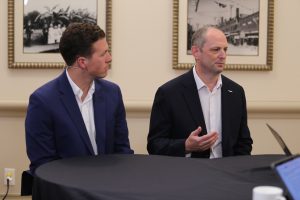
As senior vice president of global corporate affairs at Amazon Inc., Carney (pictured) is responsible for public relations and policy for the company founded and led by Jeff Bezos, who purchased the Post in 2013. Carney joined Amazon, now the world’s most valuable business by market value, after serving as press secretary for former President Barack Obama and former Vice President Joe Biden.
His prior experience parrying media questions about global nuclear disarmament and the national debt has undoubtedly prepared him for the hot seat he now occupies, as Amazon and other large tech powerhouses have increasingly come under fire over issues such as data privacy and possible anti-competitive practices.
“You can’t be in a more exciting space if you’re going to be in the private sector engaging in policy,” Carney said. “The space is fascinating because issues really are front and center right now around questions about technology, and how to ensure that it continues to evolve in a way which allows for innovation, but also protects privacy, civil liberties and the like.”
Carney spoke with John Furrier and Rebecca Knight, co-hosts of theCUBE, SiliconANGLE Media’s mobile livestreaming studio, during the AWS Public Sector Summit in Washington, D.C. They discussed concerns regarding facial recognition technology, the need to build dialogue with public officials, how the company is addressing potential antitrust issues and Amazon’s success in winning major contracts with government agencies (see the full interview with transcript here). (* Disclosure below.)
This week, theCUBE features Jay Carney as its Guest of the Week.
Amazon sits at a crossroads today between the benefits of technology innovation to improve the world and concerns that personal privacy will take a serious hit in doing so. An example of this tech policy dilemma can be found in Rekognition, Amazon’s facial recognition software.
Using artificial intelligence and machine learning, Rekognition analyzes still images and video of people. Users of the tool, such as governments and businesses, can build private databases to match stored files against those images. Not surprisingly, enthusiastic users of Rekognition have been law-enforcement agencies that have employed the tool to solve crime. Nonprofit groups, such as Thorn and the International Centre for Missing and Exploited Children, are also using it to generate leads on missing children or human trafficking victims.
However, the tool has raised an outcry among privacy advocates who fear its potential for misuse.
“As we scrutinize and explore regulating some of these arenas, we should do it in a way that creates public benefit, that prevents whenever possible, misuse of technology, but continues to allow the kind of innovation that’s made the United States the center of technological innovation over the last 30 or 40 years,” Carney said. “That’s not an easy job, but I think that folks in tech need to work with and collaborate with regulators and lawmakers to talk about how to do that.”
To engage in dialogue, Amazon relies on an extensive in-house policy operation, led by Carney, that includes approximately 250 people. Among them are Michael Punke, formerly the U.S. ambassador to the World Trade Organization, who leads global policy for Amazon Web Services Inc., and Brian Huseman, previously chief of staff at the Federal Trade Commission and former senior policy counsel at Intel Corp.
Amazon also has not been shy about participating in the political contributions process. Amazon PAC, the firm’s political action committee, increased its spending to $1.8 million in 2018, triple the amount given two years before. Yet, Amazon’s political spending doesn’t even crack the top 20 corporate contributors list in 2018.
Carney and his staff believe that a process of education will help Amazon’s cause as it grapples with concerns around its size and technology power. “One thing we do with the team we have in D.C. is be a resource of information, try to explain what’s happening, how our model works, how the technology works,” Carney said. “That can only help as regulators and lawmakers decide how they want to approach these problems.”
Amazon’s sheer size still makes it a significant target for government regulators who may be looking to scale back Big Tech’s market influence by exercising antitrust laws. That has resulted in the unusual sight of the world’s largest retailer trying to look small.
Amazon’s CEO has pointed out that his company remains a small player in global retail. And in Amazon’s annual shareholder letter, Bezos noted that its share of the e-commerce market in the U.S. had dropped from 47% to 38%.
Carney also pointed out that by opening its website to other sellers, Amazon has created its own competition. Nearly 55% of products and inventory for sale on its website are non-Amazon, according to Carney.
“There’s a perception that Amazon itself is singular so that you buy from Amazon and therefore you’re not buying from somebody else,” Carney said. “That side of our business is growing much faster than the Amazon retail business, and it demonstrates the value proposition for all of these small and medium-sized sellers.”
If the U.S. decides to move against Amazon for antitrust reasons, it could raise a complicated discussion since the federal government itself is poised to play a major role in expanding Amazon’s cloud business. AWS has emerged as a finalist, along with Microsoft Corp., for the $10 billion Joint Enterprise Defense Infrastructure, or JEDI, contract, which would select one company to provide cloud services for Department of Defense operations around the globe.
If it wins the lucrative deal, it would not be the first time AWS has garnered major government business. In 2013, the Central Intelligence Agency awarded a $600 million cloud computing contract to Amazon.
“It demonstrates that we’re very customer-focused, and it’s especially true when it comes to our national security agencies and defense agencies,” Carney said. “Security is our first concern at AWS.”
To run Amazon, Bezos has created an “S-team” of 18 senior executives, which includes key players such as Andy Jassy, CEO of AWS, and Tom Taylor, senior vice president of Alexa management. Carney is also a member of the elite team.
When Carney left the White House in 2014 and returned to private life, he told reporters he had no plans to write a book. He remains one of the few central figures in the Obama presidency not to have published memoirs. Given his key role in the White House and now as a member of Amazon’s inner sanctum, whenever Carney gets around to writing his autobiography, it should be quite a tale.
Here’s the complete video interview, part of SiliconANGLE’s and theCUBE’s coverage of the AWS Public Sector Summit. (* Disclosure: TheCUBE is a paid media partner for the AWS Public Sector Summit. Neither Amazon Web Services Inc., the sponsor for theCUBE’s event coverage, nor other sponsors have editorial control over content on theCUBE or SiliconANGLE.)
Support our mission to keep content open and free by engaging with theCUBE community. Join theCUBE’s Alumni Trust Network, where technology leaders connect, share intelligence and create opportunities.
Founded by tech visionaries John Furrier and Dave Vellante, SiliconANGLE Media has built a dynamic ecosystem of industry-leading digital media brands that reach 15+ million elite tech professionals. Our new proprietary theCUBE AI Video Cloud is breaking ground in audience interaction, leveraging theCUBEai.com neural network to help technology companies make data-driven decisions and stay at the forefront of industry conversations.