 BIG DATA
BIG DATA
BIG DATA





BIG DATA

HG Insights Inc., a provider of data-driven intelligence and buyer intent signals for business-to-business sales and marketing organizations, today introduced a new platform and agentic infrastructure aimed at addressing what it sees as fundamental gaps in how go-to-market teams use data and artificial intelligence to drive revenue.
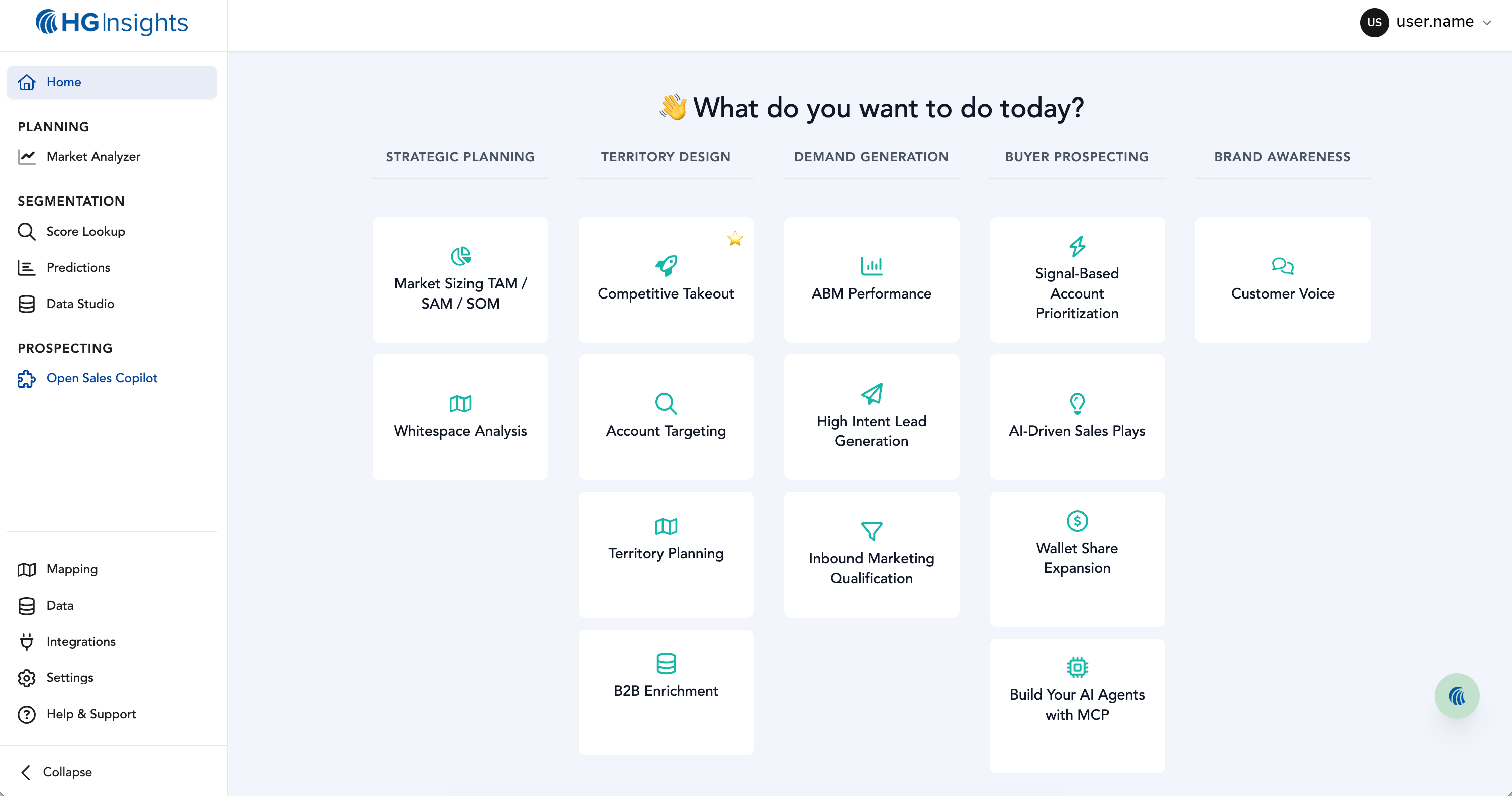
The company today unveiled its Revenue Growth Intelligence Platform, described as a unified system that brings together technographic data, buyer intent signals, information technology spending intelligence and contact data into a single AI-supported analytical environment. HG Insights is also rolling out an early-access version of Agent Builder, which lets enterprises create custom AI agents that operate across their sales and marketing stacks.
The company is positioning its offering as a response to what Chief Executive Rohini Kasturi described as structural limitations in existing go-to-market architectures. At the core of the platform is what the company calls its “Revenue Growth Intelligence Fabric,” a large-scale data layer built from nearly 50 petabytes of aggregated and curated third-party information the company has collected over 15 years and refined with AI intelligence into what Kasturi described as a domain-specific model for go-to-market intelligence.
That data foundation is intended to address what HG Insights executives characterize as a persistent “data crisis” in sales and marketing organizations. Companies typically rely on multiple vendors for different datasets, resulting in islands of often inconsistent information scattered around the organization. “You source technographic data from this vendor and firmographic data from the other vendor, and the data is fragmented,” said Nik Koutsoukos, vice president of product marketing.
The RGI Platform attempts to consolidate those inputs into a single system that feeds multiple AI-driven copilots for market analysis, revenue operations and sales execution. Each is designed to guide users through workflows rather than simply present dashboards.
The platform’s copilot model is an attempt to create a more controlled approach to AI than fully autonomous agents. While agentic processes run in the background, users remain in the loop through guided workflows.
“The co-pilots literally guide the user in a step-by-step workflow,” Koutsoukos said. “You can see what the co-pilots and the agents are doing.”
The Agent Builder product leverages Model Context Protocol interfaces, enabling customers to integrate proprietary data and workflows with HG’s intelligence layer.
Kasturi described Agent Builder as a natural extension of the platform’s architecture. “If you use our MCP server on top of our fabric, customers can build custom agents that are fully autonomous,” he said.
HG Insights said a key differentiator is the depth and structure of its data. Its taxonomy assigns a unique identifier to each entity in its dataset, enabling disparate data points such as technology usage, spending patterns and buyer intent to be consolidated into a unified profile.
Kasturi said that makes it possible for the system to alert a salesperson to churn risk based on multiple signals, such as a key contact leaving a customer company or evaluating competing products.
The company is also shifting its business model to align with this AI-driven approach. Pricing is now based on a consumption model tied to data usage rather than traditional licensing. Pricing is consumption-based with an annual subscription buying a certain number of credits.
Kasturi said HG Insights is framing the platform as part of a broader transition in enterprise AI from efficiency gains to revenue generation. Rather than focusing on cost reduction, the company is emphasizing measurable business outcomes such as pipeline growth and conversion rates.
“We don’t want to solve the efficiency problem,” he said. “Efficiency should be a natural benefit. We want to tie it to the revenue growth and the retention problem that every customer has.”
HG Insights is also looking to expand beyond its traditional base in B2B technology firms. While the company boasts of serving 90% of Fortune 500 tech companies, executives said the new platform’s broader data coverage and AI capabilities make it applicable across a wider range of industries.