 INFRA
INFRA
INFRA
INFRA


INFRA

Normal Computing Corp., a startup that’s trying to reinvent the fundamental physics of artificial intelligence, said today it has raised $50 million in a new funding round led by Samsung Catalyst.
Today’s preemptive round also saw participation from Galvanize, Brevan Howard Macro Venture Fund and ArcTern Ventures, plus existing backers Celesta Capital, Drive Capital, Micron Ventures and Eric Schmidt’s First Spark Ventures. It brings the company’s total amount raised to more than $85 million.
Normal says it’s trying to fix what could ultimately prove to be an existential crisis for the AI industry. As AI models scale up and become more powerful, the chips they run on require increasing amounts of power to run. Chief Executive Faris Sbahi says the industry is fast approaching an “energy wall,” as conventional graphics processing units demand prohibitive amounts of energy that will soon be impractical to supply.
The startup intends to fix this problem by doing two things: First, it intends to transform the way silicon chips are designed, and second, it plans to use its new methods to create a fundamentally new kind of processor that embraces the laws of physics instead of trying to oppose them.
Before it can even hope to change how chips work, Normal says, it needs to rethink how they are made. That’s why it developed the Normal EDA, or electronic design automation platform, which is currently being used by half of the world’s top 10 semiconductor design firms.
AI has already transformed the way people code, but its impact on chip design hasn’t been anywhere near as significant. The Normal EDA platform changes that, using a frontier AI technique called “auto-formalization.” It combines large language models with formal logic to help engineers design, optimize and prove the correctness of their silicon designs.
The idea is that the AI learns the intent behind new chip designs, before helping to suggest better ways of doing it and make them run more efficiently. It can help to compress chip development times from years into just months, as an additional benefit, the company says.
“Meeting growing ‘intelligence-per-dollar-per-watt’ demands a fundamentally novel architecture,” Sbahi said. “Normal EDA exists to accelerate custom silicon to market by two times today, and over time, to enable 1,000-times gains in efficiency with our platform.”
But the more ambitious aspect of Normal’s vision is not to change the way chips are designed, but to alter the way they compute. The company explains that existing silicon chips require vast amounts of energy trying to keep transistors in rigid “0” or “1” states to minimize power and heat generation.
Normal, on the other hand, implements thermodynamic cooling that allows it to avoid fighting the inherent randomness of physical systems. Its physics-based application-specific integrated circuits harness thermal dynamics to perform computations in order to improve the efficiency of silicon-based compute.
It works by treating nature’s randomness as a feature rather than a bug. So in contrast to traditional GPUs that use massive amounts of energy trying to suppress noise and ensure a perfect “0” or “1” state, Normal’s ASICs let the system fluctuate naturally, harnessing the noise to perform computations.
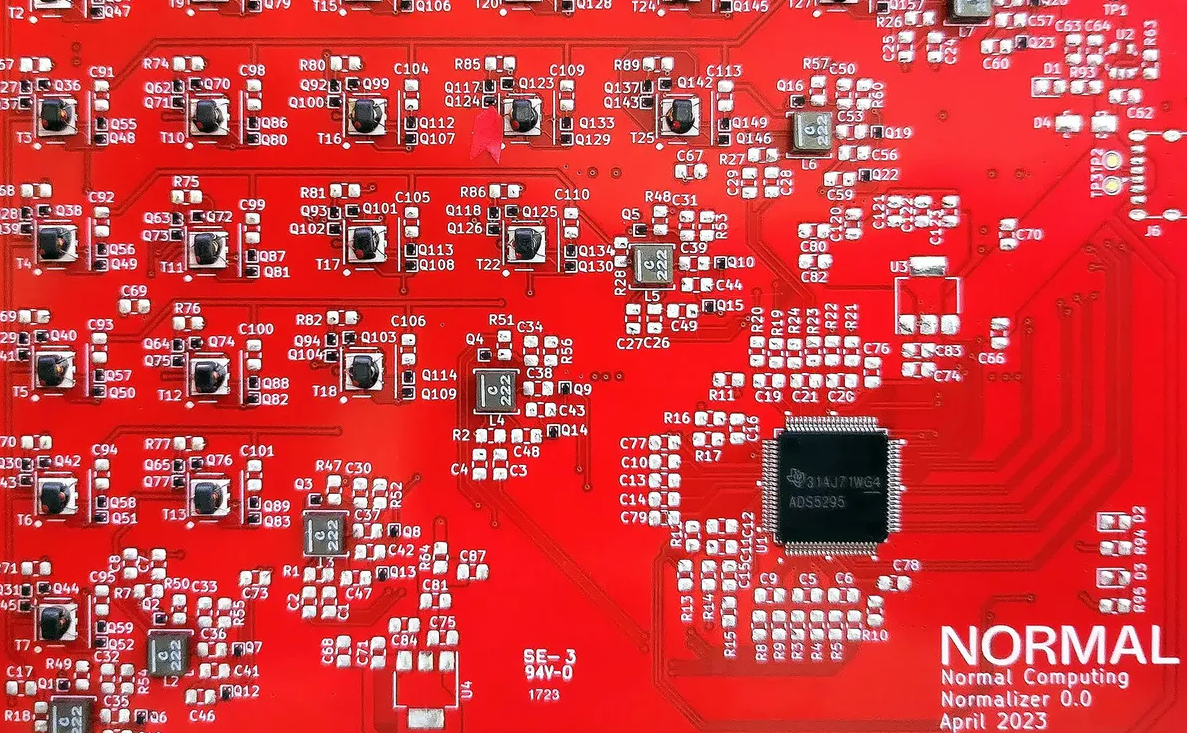
The company has already taped out the world’s first thermodynamic computing chip. It’s called the CN101, and it’s the first step toward the company’s ambitious goal of 1,000-times energy efficiency gains.
Normal is researching its thermodynamic chip architecture in collaboration with the U.K.’s Advanced Research and Invention Agency, known as ARIA. Suraj Bramhavar, who is director of ARIA’s Scaling Compute program, said his own research is focused on helping the chip industry move away from incremental performance gains and take a giant leap, with transformational improvements.
That’s why he’s so keen to work with Normal. “Its team has taken a fundamentally unconventional approach and delivered working silicon in CN101,” Bramhavar said. “That is an exceptionally rare outcome for work this ambitious.”
Support our mission to keep content open and free by engaging with theCUBE community. Join theCUBE’s Alumni Trust Network, where technology leaders connect, share intelligence and create opportunities.
Founded by tech visionaries John Furrier and Dave Vellante, SiliconANGLE Media has built a dynamic ecosystem of industry-leading digital media brands that reach 15+ million elite tech professionals. Our new proprietary theCUBE AI Video Cloud is breaking ground in audience interaction, leveraging theCUBEai.com neural network to help technology companies make data-driven decisions and stay at the forefront of industry conversations.