 INFRA
INFRA


INFRA

Awareness of the network’s role in AI has steadily increased, with much of the focus on the back end – larger clusters, faster ports, and scale-across fabrics that stitch GPUs together across data centers. Arista Networks Inc. has seen continued, accelerated growth and has been one of the biggest winners of that buildout.
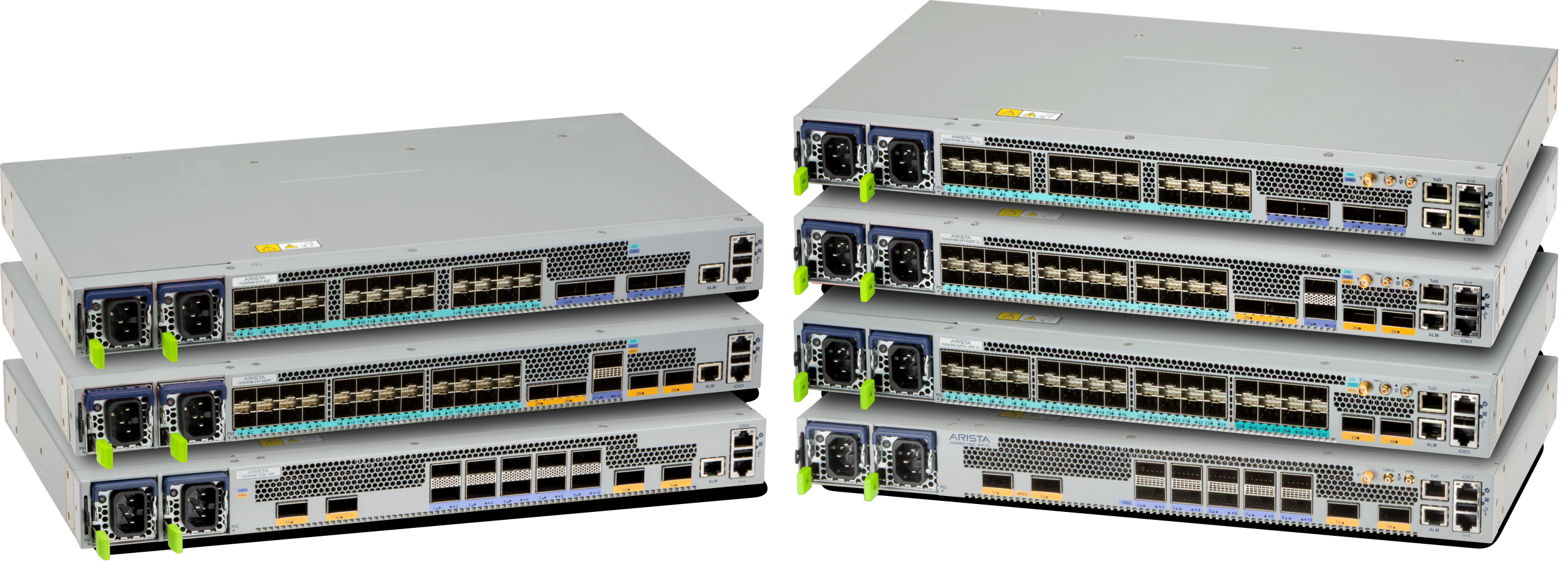
This week at SC26, Arista announced a shift in focus to the other side of the network. The company also announced a new set of Etherlink R4 routing platforms designed for what it calls distributed inferencing, along with a pluggable optical line system for data center interconnect. The lineup includes:
All are based on Broadcom’s Jericho and Qumran silicon, designed to deliver up to 60% lower power consumption than competing 7nm and 16nm platforms. Everything is available now, except the 7020HR4, which ships in early 2027. The speeds and feeds always make headlines, but the implications of the launch point to where AI infrastructure is heading.
During a pre-briefing, Brendan Gibbs, Arista’s AVP of product line management, argued that the forces driving training across multiple sites will have the same effect on inference. Gibbs also said that roughly 30% of Arista’s AI business is now scale-across, indicating that distributed AI is rapidly becoming commonplace.
Inference will be distributed for three reinforcing reasons:
The implication is that the front-end network, long treated as plumbing, now needs back-end attributes: deep buffers, traffic engineering, multi-tenancy, and encryption, because traffic now leaves the building.
This launch is the opposite of the descriptors we typically associate with Arista. Recent announcements focused on dense 800G, 1.6T, and liquid cooling. The products launched at SC26 are smaller and less expensive. Arista dominates big iron and is now rounding out its portfolio. Arista’s customers range from hyperscalers to neoclouds to enterprises building local AI. The front end needs rich features, not massive bandwidth, and Arista hasn’t had a viable option for that tier until now.
These routers are designed as entry-level but ship with 400G uplinks, which may seem like overkill today but offer investment protection. Gibbs said the goal is a 10-year life cycle, with customers swapping optics rather than chassis. No one knows what agents will do to traffic volumes, and I suspect companies that consider this overkill today will think differently in three or four years. Headroom is cheaper than a forklift upgrade at a remote site. Also notable: Arista co-designed the 7280R4 with a hyperscaler seeking a gray-to-coherent bridge, a sign that it’s building with its biggest customers.
The most intriguing product is the hardened 7020HR4, built for 5G and AI-RAN cell sites. Telcos have largely sat out the AI buildout, yet they own the last mile and real estate near users, exactly what low-latency inference requires. This gives a carrier the backbone to offer a managed AI factory.
My view is that this performs better outside the U.S., where enterprises don’t trust carriers beyond connectivity. In Europe and Asia-Pacific, managed services are far more common, and providers such as BT, NTT, and Telstra have the footprint to make it work. With sovereignty requirements, the opportunity for telcos to move up the stack has never been better. Telcos have never been a core market for Arista, so any growth from that audience is additive to their already massive TAM.
Since 2019, Arista has reported a far lower CVE count than competitors, even after the surge in AI-assisted discovery following Anthropic’s Mythos. I’m skeptical of CVE comparisons because counts depend on testing rigor, installed base, and reporting practices, and some vendors now bundle multiple issues into a single CVE.
The more relevant benefit is operational. Customers often don’t apply patches because upgrades cause downtime and break things. If they trust the software, they patch faster, and the risk window shrinks. With Mythos accelerating the retirement of end-of-support gear, quality and longevity become buying criteria, not nice-to-haves. On the call, Gibbs agreed it’s hard to draw conclusions from CVE counts but explained that CVE counts were a measure of Arista’s software quality. This has been Arista’s calling card since it was a startup. While CVEs provide one metric, the bigger proof point is its historical track record of quality software.
Also, wire-speed MACsec and IPsec on every port is a differentiator because AI brings different security requirements. However, integrated security does not replace firewalls. I asked Gibbs about this, and he said that Arista has no intention of replacing firewalls and expects Palo Alto Networks to continue to sit behind it in the line. I’d like to see that formalized into validated designs for distributed inference, like what Nvidia-validated designs did for the back end.
The optical line system is a similar simplification play. Arista isn’t an optical company and is reselling these products, but offering dark fiber customers a turnkey, EOS-integrated way to move 25.6 Tbps across a metro network removes a real headache.
Customers have responded positively to Arista’s entry into this market. Douglas Fast Net CTO Jon Vradenburg said the company needs “a compact platform that supports the services our business and carrier customers rely on.” Takayuki Sakou of Japan’s STNet cited “higher throughput and improved power efficiency while maintaining the quality of the EOS software we trust.”
Considerations for network professionals
The back end of AI networking is largely a solved architecture at this point. The front end is not, and that’s where the next round of competition will play out. With R4, Arista is betting that its routing credibility, built quietly within hyperscaler backbones, can make it the default there as well. Given how much traffic agentic AI is likely to generate, that’s a bet that, like most Arista bets, will likely pay off.
Zeus Kerravala is a principal analyst at ZK Research, a division of Kerravala Consulting. He wrote this article for SiliconANGLE.
Support our mission to keep content open and free by engaging with theCUBE community. Join theCUBE’s Alumni Trust Network, where technology leaders connect, share intelligence and create opportunities.
Founded by tech visionaries John Furrier and Dave Vellante, SiliconANGLE Media has built a dynamic ecosystem of industry-leading digital media brands that reach 15+ million elite tech professionals. Our new proprietary theCUBE AI Video Cloud is breaking ground in audience interaction, leveraging theCUBEai.com neural network to help technology companies make data-driven decisions and stay at the forefront of industry conversations.