 INFRA
INFRA
INFRA
INFRA



INFRA

The race to integrate quantum computing with classical high-performance computing has crossed from academic debate into operational imperative, as national laboratories and federal agencies mobilize to achieve quantum-HPC convergence — and make the hybrid stack a foundational pillar of scientific discovery.
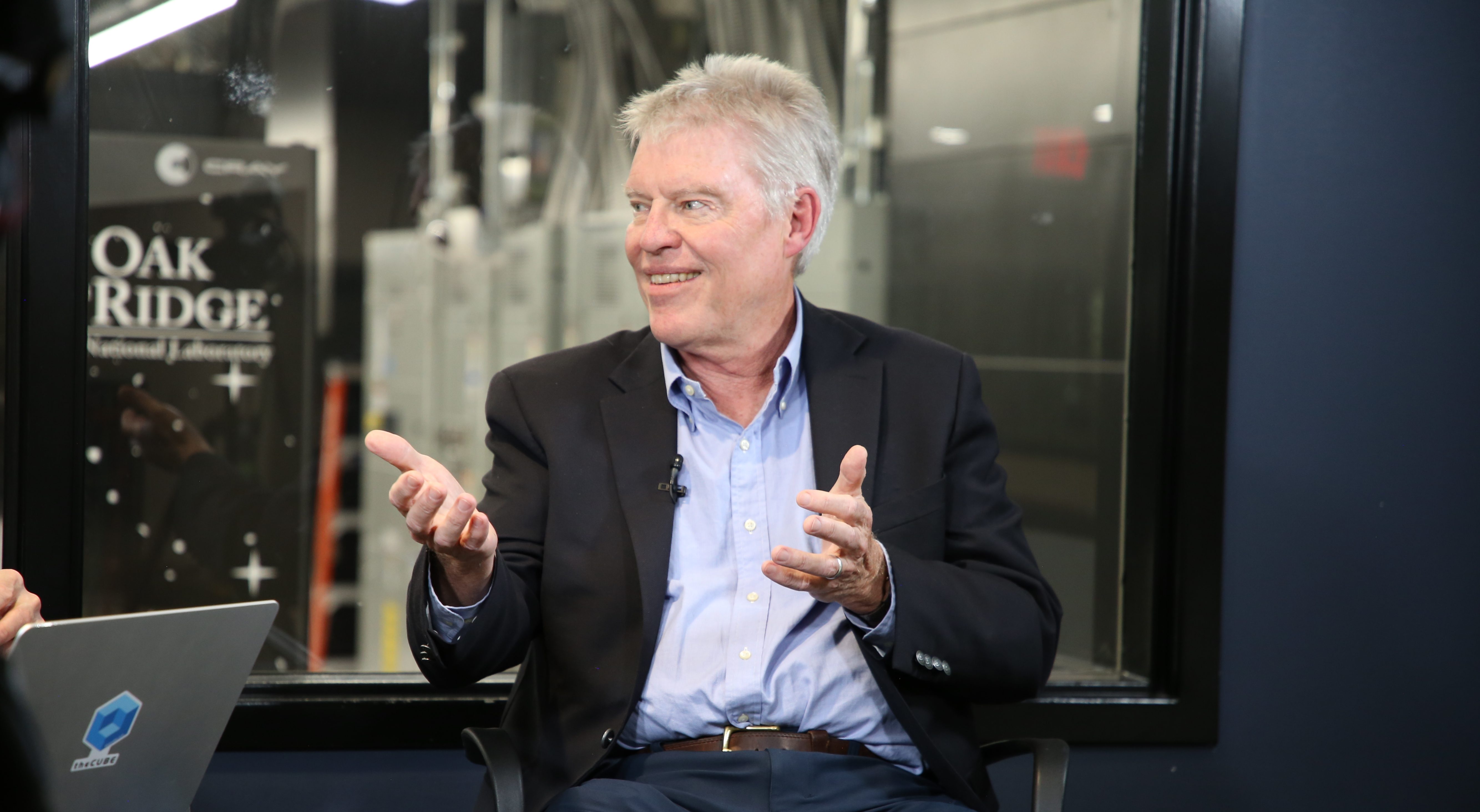
As the quantum computing market moves toward a potential $97 billion global opportunity by 2035, the core engineering challenge — linking quantum devices to exascale supercomputers in a way that is fast, reliable and scientifically useful — remains largely unsolved. That integration problem sits at the center of the work underway at the U.S. Department of Energy’s Oak Ridge National Laboratory, according to Tom Beck (pictured), section head for science engagement and acting group leader for quantum-HPC at Oak Ridge National Laboratory.
“Quantum is a rapidly-growing capability. We see that as the next frontier in high-performance computing, but it’s likely to be, at least initially, a more specialized accelerator of certain computational workloads,” Beck told theCUBE. “It’s really a game of transfer of information. How do you accelerate the flow of information between the two machines and do the hardest thing on the quantum device?”
Beck spoke with Dave Vellante at the HPE World Quantum Day event, during an exclusive broadcast on theCUBE, SiliconANGLE Media’s livestreaming studio. They discussed quantum-HPC convergence, AI, the path to quantum error correction and ORNL’s fusion energy research program. (* Disclosure below.)
The hybrid computing model is not a theoretical future state — it is already being pursued at scale, Beck explained. ORNL, Nvidia Corp. and Hewlett Packard Enterprise Co. are jointly advancing quantum-HPC integration for scientific discovery, and the DOE’s Genesis Mission has explicitly named quantum-AI-HPC convergence as one of its core national priorities. The practical bottleneck today, however, is not ambition — it is error correction, he noted.
“Quantum chips, so to speak, or devices or qubits, have more errors than classical devices,” he said. “At the current state, we think we may need hundreds of qubits — physical qubits — to have one logical qubit in a device. That’s a big barrier because it’s not like that on a classical HPC issue.”
Despite that barrier, Beck expressed growing optimism. The vendor ecosystem has matured considerably, and different qubit architectures — superconducting, ion trap and neutral atom — are each making progress on distinct performance dimensions, he explained. Crucially, AI itself may hold the key, as machine learning applied to classical machines is being used to design more efficient quantum circuits and potentially accelerate error correction, Beck added.
“I’ve watched the development of the vendor industry and how they’re developing new chip or qubit technologies,” he said. “Error correction is making progress. I really do feel that it is moving in a positive direction, and within a few years, we will be in a very different place.”
Beck offered a vivid framing for the underlying I/O challenge that still constrains quantum utility even when qubits perform well: “You have this vast ocean of possibility, but you can only access it through small pipes.” The problems ORNL tends to prioritize are those that do not require massive inflows of classical data — a constraint that shapes which scientific workloads, from nuclear fusion modeling to quantum chemistry, are the best candidates for early hybrid quantum-HPC workflows.
“I would say what’s even more exciting is the fact that we’re starting a project on fusion energy, and the purpose is to set up a scheme that utilizes all three of those spaces — AI, quantum and HPC — to really solve a problem, not just a pipe dream, but to really apply the correct things at the correct places,” Beck said.
Here’s the complete video interview, part of SiliconANGLE’s and theCUBE’s coverage of the HPE World Quantum Day event:
(* Disclosure: TheCUBE is a paid media partner for the HPE World Quantum Day event. Neither HPE, the sponsor of theCUBE’s event coverage, nor other sponsors have editorial control over content on theCUBE or SiliconANGLE.)
Support our mission to keep content open and free by engaging with theCUBE community. Join theCUBE’s Alumni Trust Network, where technology leaders connect, share intelligence and create opportunities.
Founded by tech visionaries John Furrier and Dave Vellante, SiliconANGLE Media has built a dynamic ecosystem of industry-leading digital media brands that reach 15+ million elite tech professionals. Our new proprietary theCUBE AI Video Cloud is breaking ground in audience interaction, leveraging theCUBEai.com neural network to help technology companies make data-driven decisions and stay at the forefront of industry conversations.