 AI
AI
AI
AI









AI

The artificial intelligence arms race has spent the last two years obsessed with a duopoly of constraints: the desperate hunt for Nvidia Corp. silicon and the grueling wait for grid-scale megawatts. In the Valley, the mantra was simple: If you have the chips and the juice, you’re winning.
But as the market matures from experimental “science projects” into industrial-scale infrastructure, a third, more formidable constraint has emerged. It’s not a hardware bottleneck; it’s a financial one.
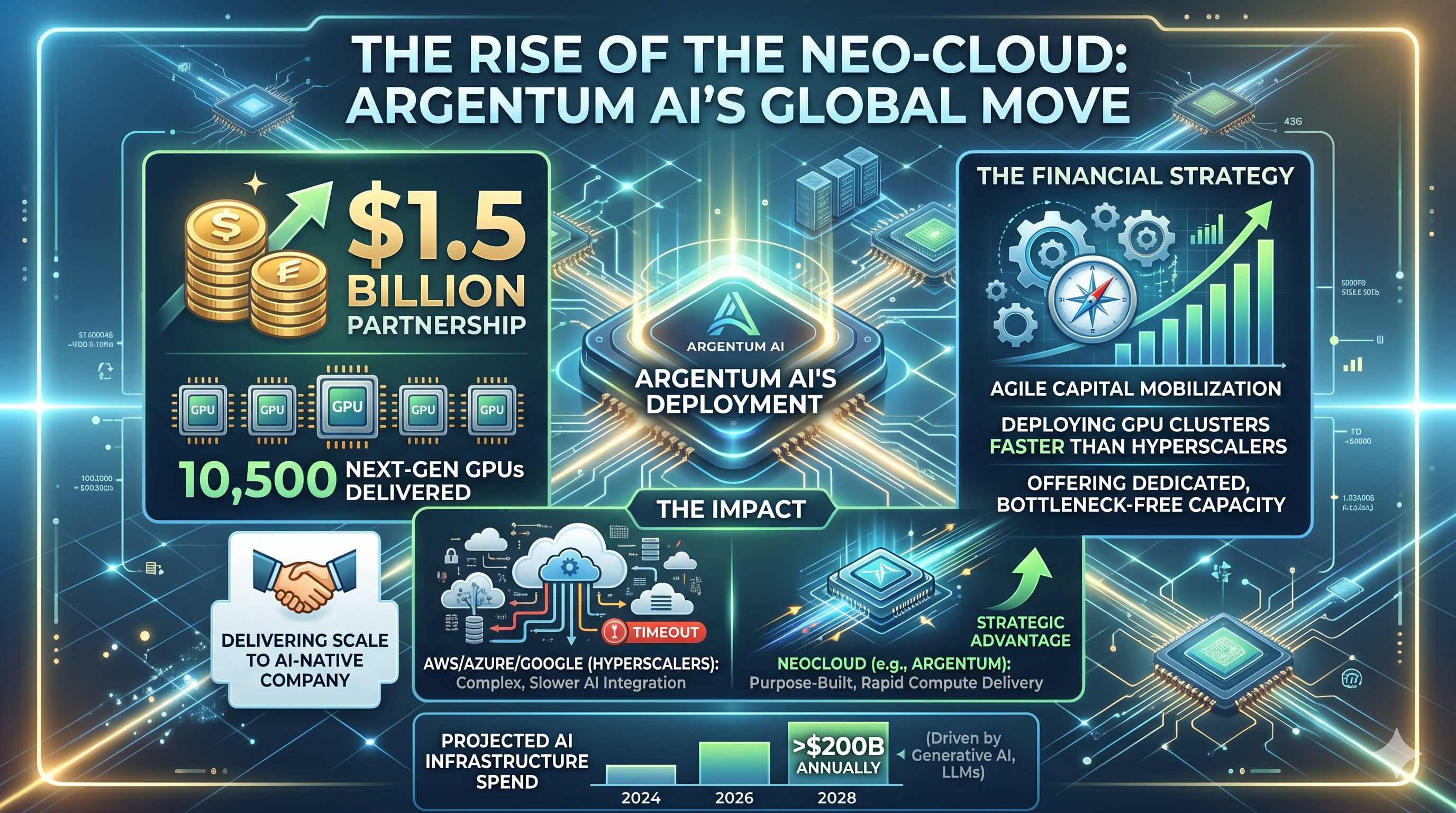
The next era of AI isn’t being defined by who can build the fastest chip or secure the cheapest power. It’s being defined by who can bridge the massive gap between raw technical demand and institutional bankability. Enter Argentum AI, a company that I interviewed a few months ago has moved from relative obscurity to aggregating a staggering $50 billion in demand interest, representing more than 400,000 graphics processing units.
With more than $1.5 billion of that pipeline already closed in recent weeks, Argentum isn’t just another “neocloud.” It is at the beginning of a new category: Infrastructure-as-a-Financial-Product.
In the Silicon Valley playbook, “disruption” usually involves a better widget. But Argentum Chief Executive Andrew Sobko isn’t selling widgets; he’s selling what he calls the triangle of truth: the deliberate convergence of power, compute and capital.
“Power and compute were always the conversation. Capital was always the constraint,” Sobko told me. “We decided to make capital a feature, not a constraint. The triangle is the product.”
For years, the industry treated financing as the “boring” back-office function that happened after the tech was built. Argentum has flipped the script. It has recognized that virtually nothing in the projected multitrillion-dollar AI infrastructure roadmap gets built without a sophisticated financial structure behind it. By mastering that structure, it seems to have built a moat that no amount of pure engineering can replicate.
The Argentum model moves with a precision that traditional hyperscalers often lack. It is essentially a masterclass in project finance applied to the bleeding edge of tech:
The result is a deployment that requires less upfront capital, moves faster, and can be replicated across multiple sites simultaneously. “Every deployment begins with a signed contract,” Sobko says. “We do not speculate on supply. The capital follows the customer, not the other way around.”
One of the biggest pain points in the current market is the “take what you’re given” mentality of large cloud providers. If you want 10,000 H200s, you go where the provider has space.
Argentum has decoupled the hardware from the geography. It has built an inventory of data center partnerships spanning eight countries and sixteen sites, totaling 2.4 gigawatts of power capacity. Because it isn’t tied to a single “owned” facility, it can treat cluster specs, cooling architecture and geographic location as variables tuned to the customer.
The same financial engineering that makes a 20,000-GPU hyperscale agreement viable can, with appropriate structuring, make a 1,000-GPU dedicated cluster available to a company that would never make a hyperscaler’s priority queue.
The financial structures powering this buildout are attracting a new class of lender. Equipment finance firms and private credit funds are now developing underwriting frameworks for GPU-secured debt — a category that didn’t meaningfully exist three years ago.
A first-lien position against a portfolio of Nvidia GPUs, collateralized by a take-or-pay contract and a residual value floor on the hardware, now looks remarkably like other equipment finance categories, such as energy infrastructure or telecom networks.
“The silicon and the megawatts are inputs,” Sobko says. “The output is a financeable, contractable, institutionally bankable cash flow stream. That is what we sell.”
The rate of AI adoption is now constrained by capital formation as much as by technology. As enterprises move from software that supports work to AI systems that execute work, the demand for persistence and dedicated supply increases.
Argentum’s rise signals that AI infrastructure is becoming a capital markets problem. The firms that solve that problem best will not just supply compute — they will determine the speed and scale of AI itself. The race for silicon is just the beginning; the race for structured capital is what will determine who gets to build the future.
Support our mission to keep content open and free by engaging with theCUBE community. Join theCUBE’s Alumni Trust Network, where technology leaders connect, share intelligence and create opportunities.
Founded by tech visionaries John Furrier and Dave Vellante, SiliconANGLE Media has built a dynamic ecosystem of industry-leading digital media brands that reach 15+ million elite tech professionals. Our new proprietary theCUBE AI Video Cloud is breaking ground in audience interaction, leveraging theCUBEai.com neural network to help technology companies make data-driven decisions and stay at the forefront of industry conversations.