 SECURITY
SECURITY
SECURITY







SECURITY

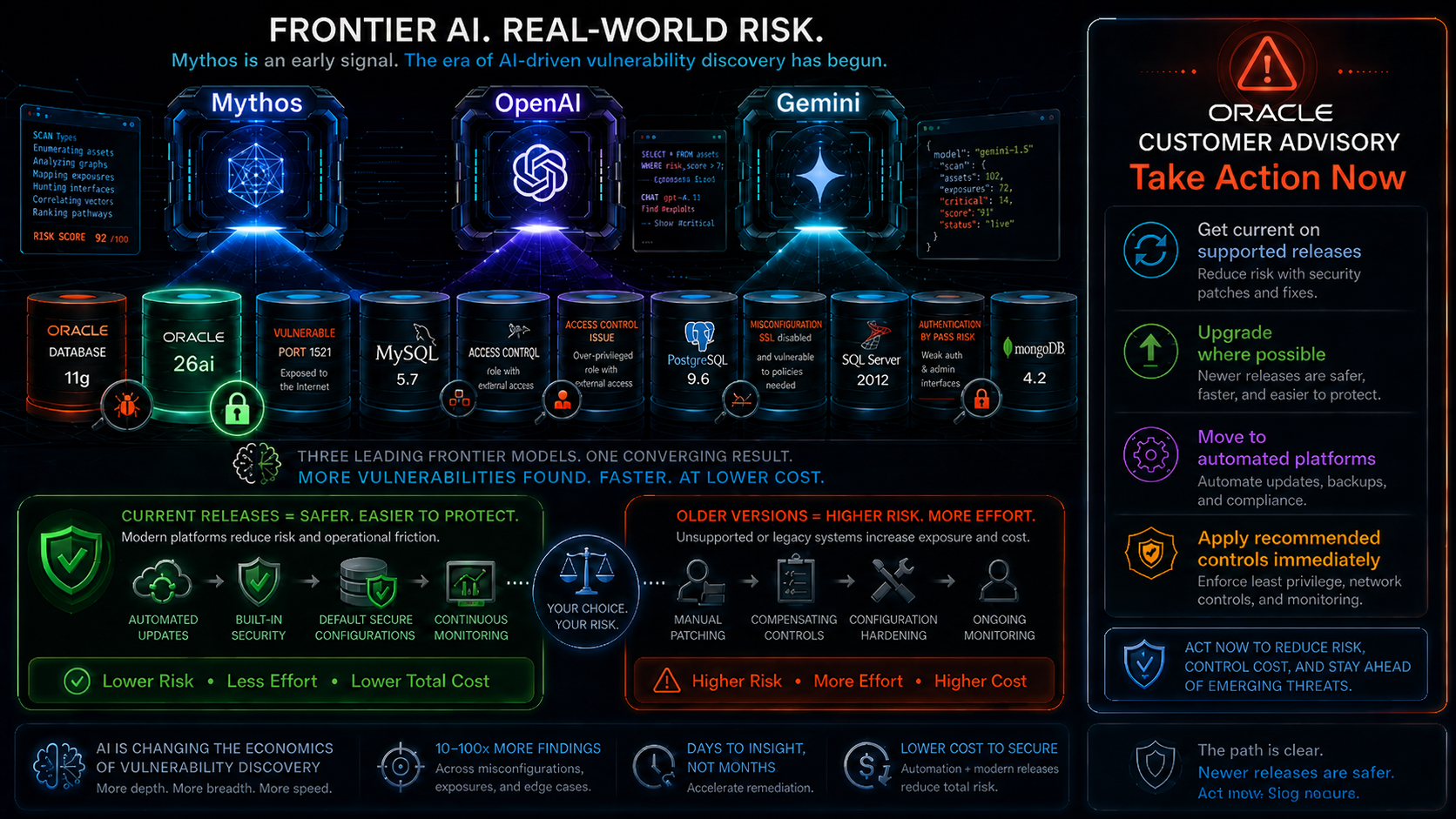
SiliconANGLE was able to review an Oracle Corp. security alert that went out to customers this week. We believe it was a direct response to Anthropic PBC’s new Mythos artificial intelligence model, and other frontier models, that significantly lower the cost for attackers to discover exploits.
In this Breaking Analysis, we give you our initial take on this development. Here’s the background:
Software security has entered a new phase. Not only are models getting better at writing code; they’re getting materially better at reading code, reasoning across systems and finding exploitable vulnerabilities that change the threat model by dramatically lowering the cost for attackers.
Anthropic’s limited release of Mythos is an important milestone. In our view, Mythos should not be seen as a one-off product announcement or an Anthropic-only development. Rather it’s an early signal of where frontier models are headed – toward deeper software understanding, automated vulnerability discovery and eventually more autonomous exploitation approaches.
We do not believe the industry should over-rotate on Mythos as a standalone event. OpenAI Group PBC, Google LLC and other leading model providers have the technical capacity, research depth and, in some cases, greater compute capacity, to deliver similar capabilities. Tasks that once required scarce expert labor – code review, dependency analysis, configuration assessment and exploit-path discovery – are becoming cheaper, faster, automated and more scalable.
This has profound implications for tech companies, their customers, enterprise software firms, and is especially acute for databases. Databases sit at the center of the enterprise attack surface. They hold the crown jewels, connect to a sprawling application ecosystem, depend on complex identity and access policies, and often carry years of accumulated configuration debt (and consequent exposures). As advanced models reduce the cost of finding weak points, the burden shifts to vendors and customers to assume that adversaries will discover misconfigurations and latent vulnerabilities faster than traditional security processes can respond.
Mythos in many ways sent a shock throughout the tech ecosystem. Organizations should not panic. But they must respond deliberately and quickly and work closely with vendors to secure their environments. This Breaking Analysis examines one vendor’s response to that reality. We think it’s a good example of how tech companies should respond generally.
It’s our position that the right response is not just adding AI features or one-off patches to a security message in response to Mythos. Instead, we view the Oracle alert as signaling the need for a more comprehensive security strategy. This is one of the earliest examples how serious infrastructure and database vendors will have to respond as AI-driven vulnerability discovery goes mainstream.
The best and safest approaches regarding “AI for security” will be those that redesign their platforms around secure defaults, continuous hardening, automated remediation, policy-driven governance and resilience against an adversary that is highly capable and whose marginal cost of attack is rapidly falling.
This is a new era and it requires new thinking around security.
In that sense, Mythos is both a catalyst and a warning. It accelerates a conversation that was already inevitable: Tech vendors must assume intelligent, automated scrutiny of their products, their configurations and their customers’ environments. The Oracle response we analyze here is therefore important as both a reaction to one model from one company, but also as a harbinger of how the tech industry must evolve in the AI era — especially as other frontier models are updated.
Close collaboration between Oracle and its frontier model vendors is the key to safeguarding enterprise data
In a leaked support note that we were able to review, Oracle is one of the first, if not the first, major tech company responding to get ahead of the novel wave of AI-enabled security threats we described above. The Oracle notification outlines how next-generation AI models dramatically accelerate the discovery and exploitation of software vulnerabilities, allowing attackers to identify weaknesses easily and chain multiple flaws into sophisticated attacks. As we’ve framed up front, this as a fundamental shift in the security landscape.
According to the support note, Oracle is partnering with leading AI model providers to get ahead of the fallout to identify and remediate vulnerabilities before they can be weaponized. Though we believe that Mythos was a catalyst, this applies to all frontier models. The support note highlights that customers running Oracle’s cloud database services, such as Autonomous AI Database and Exadata Database Service, are in a better position than customers on-premises. This is because these cloud services, regardless of location – for example, Amazon Web Services, Microsoft Azure, Google Cloud and Oracle Cloud Infrastructure – benefit from automated patching capabilities.
Note: The recommendations require organizations to accelerate upgrade and patching timelines and, in some cases, alter previous recommendations to address these new threats. Oracle has the deepest understanding of its stack and is aggressively urging its customers to be proactive and take action to safeguard their enterprise data. We encourage customers to take this seriously by thinking more broadly about combining architectural hardening, targeted patch delivery and proactive collaboration with leading AI model providers.
The best path to do so is with major tech vendors such as Oracle, because their access to leading experts at the large language model vendors is likely better than yours. And each vendor deeply understands its own stack and has the resources to guide you.
Following is an excerpt from the company’s support note:
“We understand that these new recommendations are different from what we have recommended in the past and will require customers to change their existing update plans. Unfortunately, it is not technically feasible to backport all the new security fixes to older database versions or older RUs. This is why we recommend updating to these recent versions and RUs. However, we will continue to provide backports of publicly known or high CVE vulnerabilities to older versions where it is feasible to do so.”
The support note urges customers to take immediate action by upgrading to Oracle Database 19c or Oracle AI Database 26ai, and by rapidly applying the latest quarterly Release Updates or RUs. Though that’s somewhat self-serving for Oracle, we strongly advise customers to adhere to the advice and position any added expense as part of a new and necessary security posture.
Notably, upcoming updates, including those scheduled for April and July 2026, are expected to be the first to incorporate security hardening informed directly by testing with advanced AI models. According to the support note, Oracle has streamlined these updates to prioritize security fixes, signaling a shift toward more targeted patch cycles.
In the document, Oracle advises customers to implement Transparent Application Continuity, which enables continuous availability during rolling software updates to the databases. Oracle notes that it is especially important to implement strict network isolation of databases and avoid exposing databases directly on the public internet.
From our perspective, we see this support note as an indication that Oracle is taking these threats seriously and proactively reaching out to its customer base in near real-time regarding the latest AI-enabled security threats. We expect and encourage other database vendors to follow Oracle’s lead and get highly proactive to help their customers navigate around these rapid and unexpected changes in the agentic AI era.
This security alert coincides just as Oracle has put out a spate of new product announcements, which are likely in the best position to defend against potential threats because they are built with AI in mind and are more automated. By our count, Oracle rolled out more than two dozen agentic AI products at its AI World Tour London, and, as John Furrier recently wrote, is positioning its AI Database as the control plane for AI. Security must be built into that layer.
The company then followed this up with mission-critical optimizations to Oracle AI Database at Data Deep Dive New York City, which theCUBE and I covered live from the New York Stock Exchange. This security notification to customers underscores the company’s focus on delivering mission-critical security and underscores the need to set a new bar for resilience in the agentic AI era.
Our advice to customers is they should take this seriously and immediately implement Oracle’s recommended actions, including the software upgrades, if they plan to use Oracle Database for the foreseeable future.
This is not a routine patch advisory. In our view, the first step is to determine where each environment sits on the vendor’s release curve. Customers on current or recent releases appear to have the cleaner path and are better positioned to apply the recommended mitigations, benefit from hardened defaults and reduce exposure without major operational disruption.
Customers on older releases face a more difficult tradeoff. For a better long-term outcome, they need to accelerate upgrades despite the potential of introducing unplanned costs, testing and change-management work. Such will be the norm going forward.
We believe the right posture is to segment your installed base estate by risk. Mission-critical systems, internet-facing services, highly privileged database accounts and environments with sensitive data should move first. Ask your Oracle rep for any additional information on mapping of exposure by version, configuration and workload type; identify where the new guidance supersedes prior recommendations so you are clear on the new protocol; and request explicit validation steps so teams can prove the mitigations are in place. Where upgrades are required, organizations should not position the spend as merely an unexpected tax. They should view it as part of the new cost of operating software in an era where AI lowers the attacker’s marginal cost of finding weakness.
The broader message is that security architecture must become more current, more automated and less dependent on static guidance. Customers should push vendors for secure-by-default configurations, machine-readable advisories, automated posture checks and remediation tooling that can be integrated into existing SecOps and change management workflows. The lesson from Mythos and similar models is that if attackers can use AI to dramatically shorten discovery cycles, defenders must use automation, modernization and disciplined governance to compress response cycles.
Note: We asked Oracle for a formal statement and a copy of the advisory. Oracle referred us to a related blog post and did not respond to our request to view the actual alert. In addition, we found two blogs from Jenny Tsai-Smith, senior vice president of product management for Oracle Database. One urges customers to take action and another describes resources that customers can tap as part of the Oracle AI Factory.
Support our mission to keep content open and free by engaging with theCUBE community. Join theCUBE’s Alumni Trust Network, where technology leaders connect, share intelligence and create opportunities.
Founded by tech visionaries John Furrier and Dave Vellante, SiliconANGLE Media has built a dynamic ecosystem of industry-leading digital media brands that reach 15+ million elite tech professionals. Our new proprietary theCUBE AI Video Cloud is breaking ground in audience interaction, leveraging theCUBEai.com neural network to help technology companies make data-driven decisions and stay at the forefront of industry conversations.