 AI
AI
AI
AI





AI

If the first wave of enterprise artificial intelligence was about compute and foundation models, the next is shaping up to be about the software and data infrastructure needed to make those models useful in real businesses.
The first AI winners sold compute: graphics processing units, servers, networks and cloud capacity — the “picks and shovels” of AI. But as enterprise AI moves from experimentation to deployment, a new layer of value is emerging in the software stack. Snowflake Inc. is positioning itself within that layer by focusing on the tools enterprises need to connect proprietary data to advanced AI models and manage how those systems operate. That’s where Bob O’Donnell, founder and chief analyst of TECHnalysis Research LLC, sees Snowflake’s opening.
“There’s got to be the data connection to those models,” he said. “If I can start to be the connector piece between that data and these frontier models … that opens up a lot of interesting opportunities for the software part of the picks and shovels.”
O’Donnell, who was joined by Sanjeev Mohan, founder and owner of SanjMo, talked with theCUBE’s Dave Vellante at Snowflake Summit 2026, during an exclusive broadcast on theCUBE, SiliconANGLE Media’s livestreaming studio. During the event, Vellante and Rebecca Knight spoke with Snowflake’s leaders, customers and partners about the characteristics and capabilities required to support next-era enterprise AI. (* Disclosure below.)
Here’s the complete video interview with Sanjeev Mohan and Bob O’Donnell:
Here are three key insights you might have missed from Snowflake Summit 2026:
For DoorDash Inc., supporting machine learning, analytics and agentic workflows at massive scale required a move away from monolithic architectures. The company has spent the past decade building a foundation that supports its real-time logistics business and enables its growing AI workloads, according to Vaibhav (VJ) Jajoo, head of data engineering, data platform and business intelligence at DoorDash.
“What we have learned over time is that the machine user is outpacing the human user in consumption of analytics data,” he told theCUBE. “The ML features, the feedback loops to production services or the AI agent workflows are outpacing the analytics user. When you do that, you cannot adopt a monolithic environment, which is holding you back and not letting you enable new use cases on top of it.”
Fanatics LLC is using those same data principles to personalize fan experiences. By unifying data across multiple channels and leveraging real-time insights, the company can better understand and respond to individual fan preferences, according to Kevin Longo, vice president of commercial at Fanatics.
“If you think through sports, traditionally, it’s always been a one-to-many vehicle. It’s a singular broadcast, a singular sponsor sent to a bunch of fans,” he said during the event. “Fans are not all the same. I think we’ve always known that, but now, with AI and our partnership with Snowflake, we can understand that in real time and sort of act on it.”
Beyond customer-facing personalization, organizations are also using enterprise AI to transform internal operations. At Whoop Inc., more than three petabytes of data and approximately 20 terabytes of new data generated daily have made open standards and interoperability essential, according to Matt Luizzi, vice president of analytics at Whoop.
“We’ve been putting a lot of effort into generating that clean semantic ontology over the past couple of years,” he said in an interview. “That’s really enabled us to take products like CoCo Desktop and immediately dive in and see value. What we’re seeing now is a shift in where humans are able to add value and where they’re needed to add value.”
The impact of strong data foundations extends beyond operational efficiency. SiriusXM Holdings Inc.’s strategy reflects a broader shift toward understanding not only what audiences consume, but also the context and intent behind those interactions, according to Sherene Hilal, chief ad product and technology officer of SiriusXM.
“As we’ve been starting to figure out how to make audio more modern, data and technology has been the recipe for that success,” she said during the event. “Specifically, how to get the context of audio, the mood and moment of what you’re listening to, the transcript from a podcast and really making that data available … that it’s a very tailored experience for the listener.”
Here’s the complete video interview with Chris Child, vice president of product, data engineering at Snowflake and Vaibhav Jajoo:
The rise of AI has fundamentally changed the economics of cybersecurity, compressing exploit windows and forcing organizations to move beyond traditional vulnerability management. Tenable Holdings Inc. uses Snowflake as the foundation of its security data lake while developing AI-driven remediation and automation capabilities designed to help enterprises identify and reduce risk at machine speed, according to Jason Merrick, senior vice president of product at Tenable.
“Exposure management is not a product,” he said in a discussion with theCUBE. “It’s a program. It’s not just looking at traditional IT infrastructure. It’s looking at cloud … identities… lacing it together in context within the organization [and] looking at the configuration, looking at [whether] it has known [common vulnerabilities and exposures] on it … and [then] being able to … highlight that and … reduce that risk.”
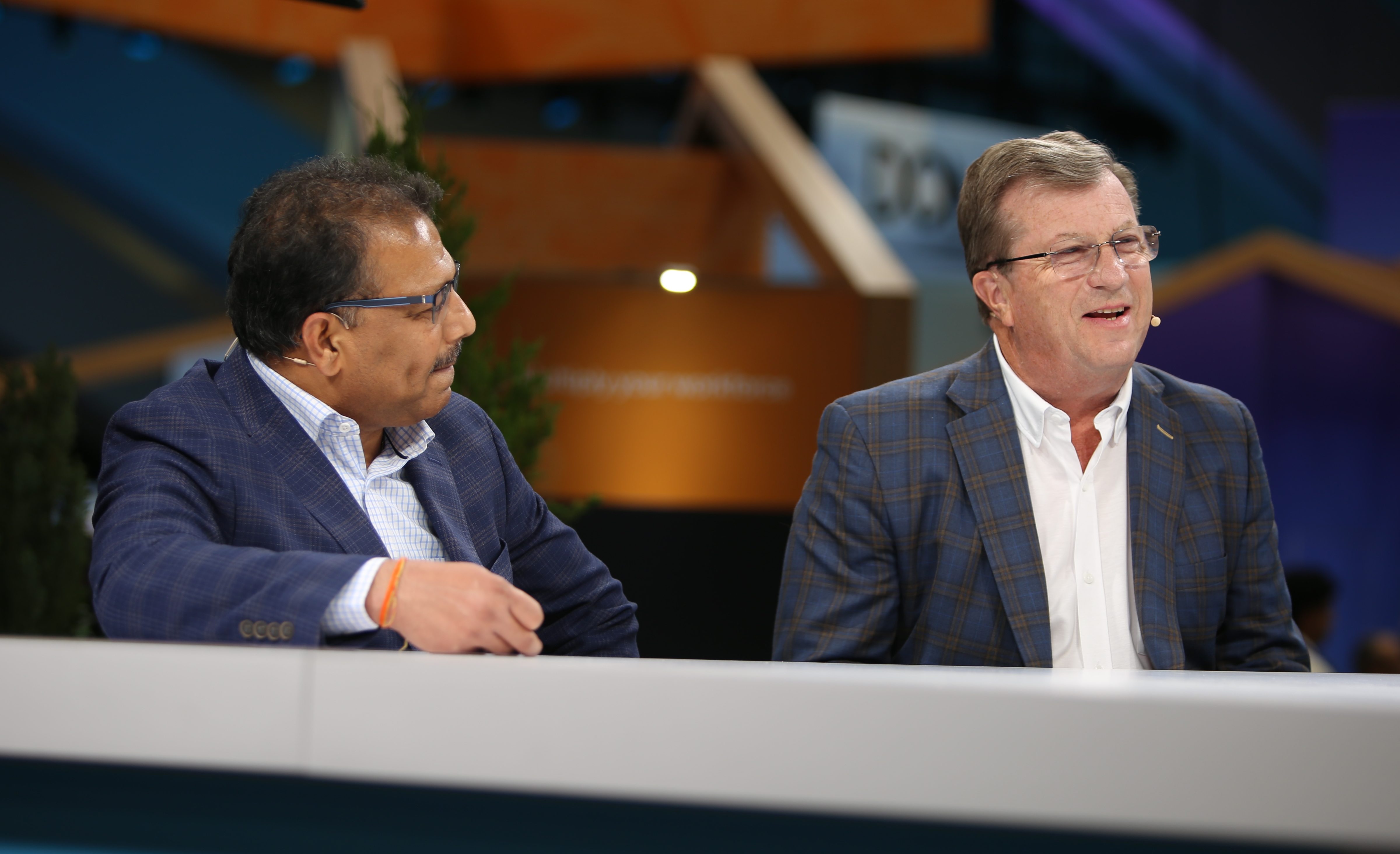
As organizations strengthen their security posture for the enterprise AI era, they are also rethinking how software gets built. At Snowflake and Clover Network LLC, a Fiserv Inc. company, AI-assisted development is accelerating software delivery while requiring new approaches to governance, standards and organizational change, according to Vinayak Kagalkar (pictured, left), senior vice president, global chief information officer and chief technology officer of Clover Network, and Mike Blandina (right), chief information officer of Snowflake.
“I think you can enforce standards in the model,” Blandina said. “As an example, in CoCo, you can just say, ‘In this particular project, anything we build, here’s a set of boundaries that you, as my agent for code development, should not cross. Here’s my standards for the type of artifacts we want to use and the type of code we want to use.’ You can do that upfront, just like you would do on a paper document and enforce through the software development life cycle.”
Trust is equally critical in healthcare, where AI-generated insights can directly influence patient outcomes. Komodo Health Inc. has spent years building a longitudinal view of more than 330 million de-identified patient journeys, creating the data foundation needed to deliver transparent, explainable AI workflows for healthcare and life sciences organizations, according to Amit Sangani, chief technology officer of Komodo Health, and Jesse Cugliotta, vice president, global head of healthcare and life sciences at Snowflake.
“The average patient chart is 46,000 words,” Cugliotta said. “If you’re walking into an emergency room and the physician has 27 other patients, they’re not reading through your entire chart history, even if they could get access to it. The ability to leverage AI … is to provide a more complete picture, to understand what is the most accurate way to work up this particular patient … that really has a critical impact not just on the caregiver’s day-to-day experience, but on the patient outcome as well.”
Here’s the complete video interview with Amit Sangani and Jesse Cugliotta:
Legal, tax and audit professionals can’t rely on systems that produce unverifiable results, making governed data and authoritative content essential components of AI adoption. Thomson Reuters has built a trusted data estate spanning thousands of governed tables and databases, creating a foundation for enterprise AI tools that professionals can confidently use in high-stakes environments, according to Caitlin Halferty, head of data and analytics at Thomson Reuters; Laura Safdie, head of legal innovation at Thomson Reuters; and Bala Kasiviswanathan, vice president of developer and AI experiences at Snowflake.
“You can’t just bring AI to an industry you don’t know; you can’t just transform a workflow you don’t understand,” Safdie told theCUBE. “If you are building for one of the most important professions in the world, you need to understand how AI can make us better and serve the public interest, while also doing it in such a way that’s fit for purpose.”
That same emphasis on trust is shaping how enterprises approach governance. At Intercontinental Exchange Inc. and the New York Stock Exchange, years of investment in governance, data quality and access controls have enabled teams to accelerate AI deployments rather than slow them down, according to Durgesh Das, vice president of data, analytics and governance at ICE/NYSE.
“Our role is actually to erase the friction,” he said during an interview. “We were already doing right data for right people with governance, but now, the opportunity for us with AI is to provide that information on time without any friction so that the business can bring their own tools and get the answers quickly.”
As enterprise AI adoption expands, organizations are also recognizing that production environments often require specialized intelligence beyond what general-purpose models can provide. Resolve AI Inc. is using domain-specific models to support site reliability engineering workflows, according to Spiros Xanthos, founder and CEO of Resolve AI.
“I see models as a way where intelligence is compressed within a model,” he told theCUBE. “If you want to have a very specific business use case, you can do a better compression with a domain-specific model — not just the speed and latency, but also actual accuracy. For more generic use cases, frontier models are generally the best answer. But if you want to have … what Resolve is working on, that actually has a very good product-market fit for a customized model to come and actually help.”
Here’s the complete video interview with Laura Safdie, Caitlin Halferty and Bala Kasiviswanathan:
For more of theCUBE’s coverage of Snowflake Summit, check out these exclusive segments:
To watch more of theCUBE’s coverage of Snowflake Summit, here’s our complete video playlist:
(* Disclosure: TheCUBE is a paid media partner for Snowflake Summit event. Neither Snowflake, the sponsor of theCUBE’s event coverage, nor other sponsors have editorial control over content on theCUBE or SiliconANGLE.)
Support our mission to keep content open and free by engaging with theCUBE community. Join theCUBE’s Alumni Trust Network, where technology leaders connect, share intelligence and create opportunities.
Founded by tech visionaries John Furrier and Dave Vellante, SiliconANGLE Media has built a dynamic ecosystem of industry-leading digital media brands that reach 15+ million elite tech professionals. Our new proprietary theCUBE AI Video Cloud is breaking ground in audience interaction, leveraging theCUBEai.com neural network to help technology companies make data-driven decisions and stay at the forefront of industry conversations.