 CLOUD
CLOUD


CLOUD

Sovereignty is everywhere right now, and most people still can’t agree on what it means and, just as importantly, what it all means to them.
This week theCUBE Research releases its new market report, Sovereign or Not? The 2026 Hyperscaler Buyer’s Guide. In this Breaking Analysis, we’re joined by its author, Amit Eyal Govrin, lead analyst for sovereign AI at theCUBE Research and CEO of Agentcy Labs, to talk about why he wrote it, what sovereignty is and what it isn’t, and what surprised him most in the findings.
The full scores are in the report. Read the full report online: Sovereign or Not? The 2026 Hyperscaler Buyer’s Guide https://siliconangle.com/sovereign-or-not
Dave: As someone who’s been leading the thought leadership in this domain, how did you come up with the inspiration to research this topic and write the report?
Amit: To understand the how, it helps to understand the why. I’ve been thinking about this subject for a while now. It hasn’t always been called “sovereignty,” but the tenets have always been the same.
It all started around four years ago, as I’ve been a builder in this space for that long. First with Kubiya, one of the industry’s first agentic implementations, deploying agents in enterprise production environments as early as September 2023, before agents were even an industry term.
We were being asked tough questions:
We were deploying as a software-as-a-service company, and many of those concerns were legitimate. As a software company, we got to keep our intellectual property and license it out. If we were successful, we would create dependency, which effectively meant customers lost control of their crown jewels.
When we started Agentcy Labs earlier this year, customers familiar with our work approached us, and many of these points crystallized for us. What they told us: We’re relieved you are no longer at Kubiya. It’s not that we ever doubted your technology or the value it brings. Quite the opposite. That was what they were afraid of. Kubiya creates a dependency, adoption balloons, and they lose control of their costs. Or a vendor changes the meter on them because of shareholder pressure or regulatory controls.
What clicked for us is that their resistance was never about Kubiya or our technology. It was about the loss of control of their alpha. Namely, the Agentic Operating System, the key driver of their artificial intelligence transformation, which falls under our technological pillar.
It doesn’t matter if the vendor is a startup, an AI lab or a hyperscaler. No enterprise can afford to mortgage its entire business on an external dependency on such a key issue. It’s far too strategic not to own outright.
That finding forced us to rethink the model behind software, dig deeper into sovereignty as an issue of control, and help the industry define it in a more standardized way.
Dave: So control is the heart of it. But when most people hear sovereignty, they think about where the data sits. Is that the wrong way to look at it?
Amit: Sovereignty goes well beyond territory, which is often the most misunderstood aspect. People hear sovereignty and immediately revert to the sovereign state: government initiatives, national security, on-premises air-gapped environments. That can be true in some cases. But by and large, our sovereignty discussions involve enterprises and regulated industries that have sovereignty as a core tenet of their AI initiatives.
It goes beyond buzzwords and sovereign-washing claims. Think back to the explosive Alex Karp interview on CNBC claiming enterprises are losing their alpha to frontier labs. I largely agree with that claim, by the way. Only he finished his pitch by offering customers to move it over to Palantir. In other words: Stop mortgaging your alpha to Anthropic and OpenAI, come rent it from us.
That interview was my trigger point to take up arms and educate the industry on sovereignty: what it is, what it isn’t, and most importantly, what you, as a buyer of AI, can do about it.
Dave: And you’ve been out in the field with buyers ever since. What did those conversations teach you, and how did that shape the framework?
Amit: Since then, we’ve been included in dozens of engagements with enterprises, governments and policymakers around the world, from Washington to Brussels, New Delhi, Sydney and even Riyadh. We are in the room when sovereignty discussions happen. That helped us shape our view, tease out the concerns, and focus on what really matters and why. From those discussions came the 5 Pillars of Sovereignty framework. We use it today to assess all vendor relationships, policy and regulation, and geopolitical events.
Dave: Which brings us to the report. You started with the hyperscalers. Walk us through how you approached it.
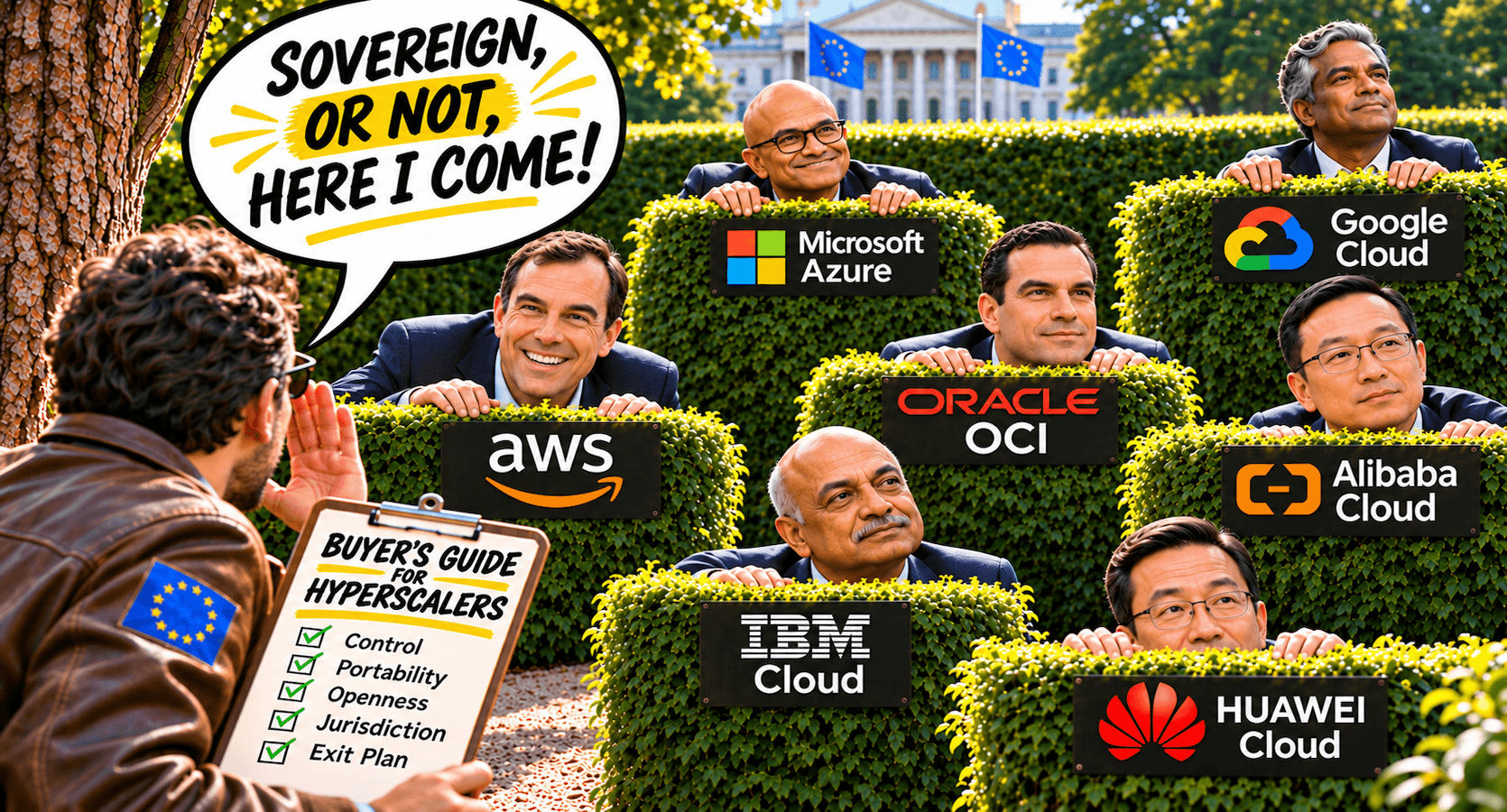
Amit: In our first edition, Sovereign or Not? The Hyperscaler Buyer’s Guide, we take the buyer’s lens and assess each hyperscaler by its sovereignty posture.
Hint: By definition, working with any hyperscaler means ceding a good portion of control over your Operational, Technological, Legal and Financial pillars. Oftentimes that’s the reality in the real world.
My view: Sovereignty is not a purity test. It’s perfectly acceptable to go with a hyperscaler, as long as it’s a known dependency you priced in as an acceptable risk. If that’s the case, let us guide you through these considerations to the best path forward for your organization.
Dave: OK, let’s get to the part everyone wants to know. Who scored what, and why?
Amit: We looked at seven hyperscalers and 40 of their offerings, from the point of view of buyers in five regions: the U.S., Europe, Asia-Pacific, Latin America and the rest, including the Middle East and Africa. Everything is scored out of 5.
The short version: The most sovereign product a hyperscaler sells is the one the hyperscaler itself can’t reach.
On these tests, sovereignty often runs inverse to how a hyperscaler is built. A shared global control plane and services the vendor runs for the customer make a cloud easy to adopt, but every layer the vendor runs is a layer the buyer does not control. Amazon Web Services and Google built their platforms around that abstraction, which becomes a hindrance once a buyer needs to run the stack without them. The grades measure how much control a buyer can take back, not the quality of the cloud.
Who came out on top, who came in last, and by how much, is in the report. And every score is backed by a source. Don’t like your grade? Publish the document and we’ll re-score it.
What’s inside the full report:
Dave: What surprised you most when you went through the findings?
Amit: None of the hyperscalers has a practical solution for the U.S. CLOUD Act, and that alone has created a real legal clawback on non-U.S. companies.
In plain English: The U.S. government can ask an American cloud company for data it controls, no matter which country the data sits in. A sovereign cloud in Brandenburg, run by a German subsidiary, doesn’t change the answer. It’s still owned by an American company.
The vendors aren’t hiding it. AWS told us as much on the record. Microsoft’s own lawyer in France told the French Senate he couldn’t guarantee French data would never reach U.S. authorities. That’s honesty, and we don’t penalize honesty. It’s the law, and it applies to every American cloud the same way.
European privacy law says you can’t just hand that data over. So a European company can end up stuck between two governments, breaking one law to obey the other. That’s the clawback.
The fixes buyers are being sold, like keeping data local, holding your own encryption keys, or a contract promise to fight requests, don’t change who the government can go to.
Dave: So what’s a non-U.S. buyer supposed to do about that?
Amit: There’s no perfect answer today, only partial ones.
Going with a hyperscaler is fine, as long as you know the risk and priced it in. What’s not fine is believing a data center in Brandenburg, on its own merits, solved your sovereignty problem.
Dave: What else jumped out at you?
Amit:
Dave: And this is just the first of several. Where do you go from here?
Amit: This is the first of a series: neoclouds, OEMs, telcos and specialized sovereign initiatives, wherever you happen to be, whether you’re a U.S., EU, Latin American, APAC or Middle Eastern buyer. Every edition covers the 5 Pillars, plus security, regulation and exit costs. Readers will be surprised by how deep we got, including quotes from the hyperscalers themselves and surveys of actual buyers. I truly think this will be valuable to everyone listening and reading.
Dave: That’s phenomenal, Amit. This is a cutting-edge report on a truly important and timely subject. If previously you were building on the frontier, you’re now squarely on the frontier of research. The scores, the vendor answers and the buyer data are all in the full report.
Read the full report online: Sovereign or Not? The 2026 Hyperscaler Buyer’s Guide
Amit Eyal Govrin is lead analyst for sovereign AI at theCUBE Research and CEO of Agentcy Labs, which designs and builds sovereign AI platforms for enterprises and governments. His research for theCUBE Research is conducted under theCUBE Research’s editorial standards and is not sponsored or directed by Agentcy Labs. Agentcy Labs may hold commercial relationships with vendors covered in this research.
Support our mission to keep content open and free by engaging with theCUBE community. Join theCUBE’s Alumni Trust Network, where technology leaders connect, share intelligence and create opportunities.
Founded by tech visionaries John Furrier and Dave Vellante, SiliconANGLE Media has built a dynamic ecosystem of industry-leading digital media brands that reach 15+ million elite tech professionals. Our new proprietary theCUBE AI Video Cloud is breaking ground in audience interaction, leveraging theCUBEai.com neural network to help technology companies make data-driven decisions and stay at the forefront of industry conversations.