 INFRA
INFRA
INFRA
INFRA






INFRA

Like most vendor event keynotes this year, Michael Dell used his Dell Technologies World 2026 keynote to argue that artificial intelligence has moved beyond experimentation and into the physical, operational core of the enterprise.
His central line, “Abundant intelligence is here,” framed the transformation not as another infrastructure refresh cycle but as the start of a new operating model in which intelligence is embedded across factories, hospitals, labs and edge environments. IBM Corp. CEO Arvind Krishna at IBM Think and Google Cloud CEO Thomas Kurian at Google Cloud Next had similar messages, and we are also likely to hear similar talk tracks at Cisco Live and HPE Discover.
The consistency is certainly good, as it’s a proof point that this is indeed where customers are. What matters are proof points and a technology roadmap that help businesses reach the end state of production AI. From an industry perspective, Dell’s talk track also revealed the tension most chief information officers feel today. The more ambitious the vision, the more unanswered questions remain about cost, complexity, governance, and who can realistically operationalize it at scale.
With that as the lens, the following are my top five takeaways from the keynote:
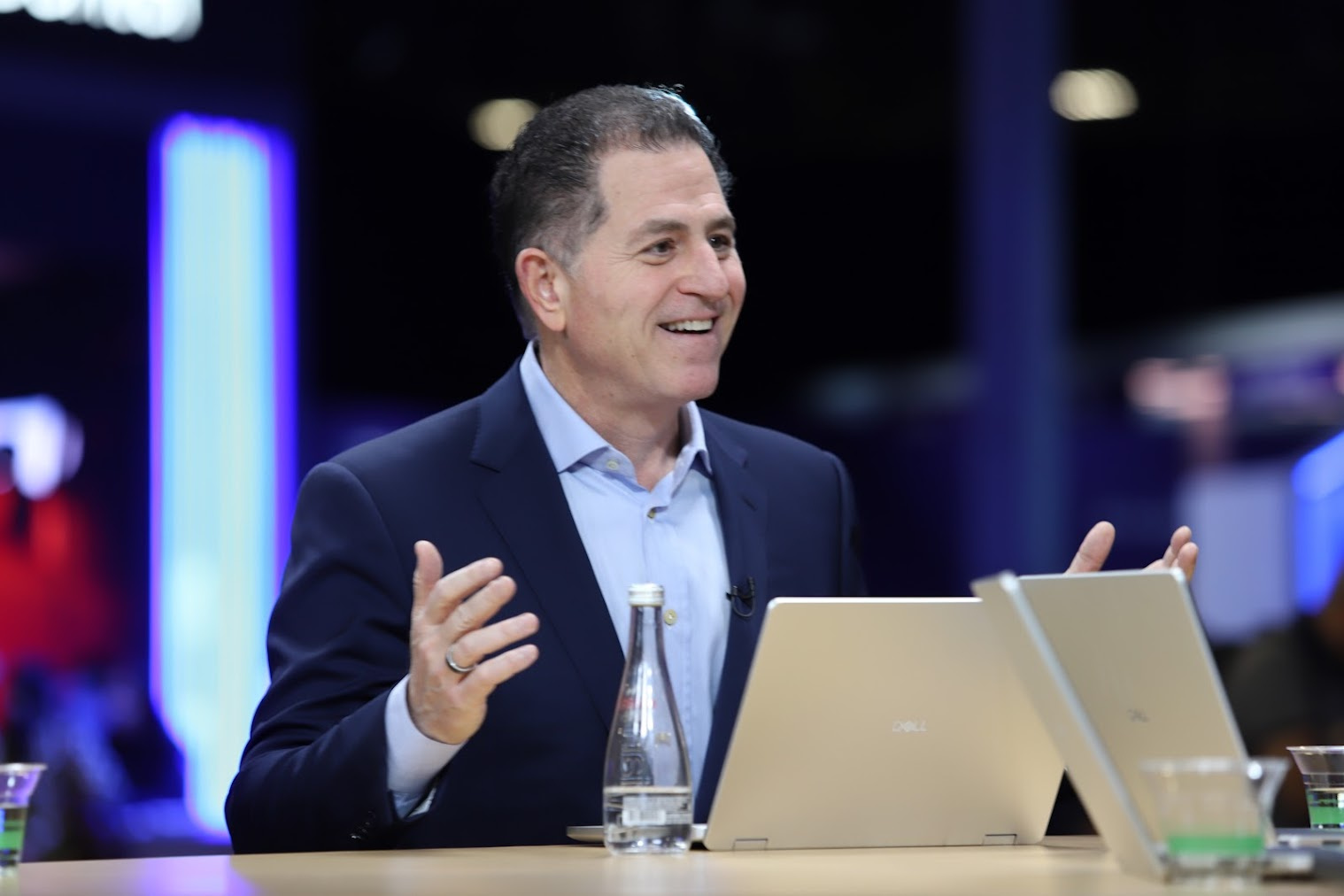
Dell’s most important message was conceptual rather than technical. “Intelligence is becoming infrastructure,” said Dell’s founder and CEO (pictured), adding that “just as electricity transformed the world when it left the power plant, AI will transform the world when it leaves the screen.” That is an effective way to reposition Dell for the AI era, shifting the conversation from chatbots and copilots to the underlying systems enterprises must buy, integrate, secure and operate.
If AI is infrastructure, then servers, storage, networking, PCs, edge systems and services shift from supporting actors to strategic control points. Dell cast itself as the company building the “distributed infrastructure that turns isolated insights into intelligence in action,” explicitly tying AI’s future to real-world environments such as oil rigs, ambulances and factory floors.
From a market perspective, that is the keynote’s real significance. Dell is not trying to win the AI race by owning the model layer. It is trying to own the enterprise deployment layer. That distinction matters because the model market will remain fluid, whereas the infrastructure and operational stack can generate longer-lasting customer relationships.
The critical point, however, is that redefining AI as infrastructure does not automatically simplify the customer path. It can just as easily become another excuse for broad platform buying before most enterprises have clear economic models, mature data foundations or the talent needed to keep these systems productive after the keynote glow fades.
Dell’s most direct strategic move was to counter the idea that AI belongs primarily in the public cloud. Citing Dell research, Michael Dell said that “67% of AI workloads already run outside the cloud” and that “88% of respondents are running at least one AI workload on prem,” arguing that “CIOs are aggressively pivoting to hybrid AI.”
He followed that with one of his strongest lines: “The risk is not the cloud. The risk is losing control of your data, your cost, your security, your intellectual property, and your speed.” In the agentic era, he argued, lock-in does not just slow innovation; it limits “what your company can become.” There is a lot of truth to that, as enterprises are discovering that AI economics differ from traditional cloud economics, especially when inference becomes persistent, token volumes explode and sensitive data cannot move freely across environments. Dell’s answer is the hybrid AI factory, where models run where the data lives and customers retain greater control over performance, security and cost structure.
The anti-cloud posturing is obviously a sales strategy for a company that benefits enormously when enterprises decide that their future AI capacity belongs on-premises, at the edge, or in co-located infrastructure that requires a lot of Dell gear. The keynote was persuasive in arguing that cloud-only AI is insufficient, but far less precise about when on-premises AI delivers better economics than managed services once utilization, skills shortages, power constraints and lifecycle costs are fully factored in.
The right answer is that it depends. Some customers will benefit greatly from running AI in public clouds, while others, particularly those concerned about sovereignty or under regulatory scrutiny, will likely go on-prem. Hybrid will be the way forward, but that adds more variables to an equation that likely won’t be solved for several years.
Like every major enterprise event in 2026, Dell Tech World was saturated with talk of agents. Michael Dell said the industry has moved beyond assistants that delivered “20% and 30% productivity gains” to “autonomous agents that plan and reason and execute and adapt and close the loop.” He argued that companies need to “completely rethink and reimagine” workflows for agentic automation and “recursive self-improvement,” promising gains of “20 and 30 times in terms of productivity improvement.”
This was where the keynote was most ambitious and least grounded. The vision is believable in pockets, especially in software development, information technology operations, customer service and highly instrumented industrial environments. Nvidia CEO Jensen Huang reinforced this by describing agentic systems as iterative engines that reason, use tools, and keep working until they complete a job, driving computation requirements up by “100x, 1,000x.”
But the practical question for most enterprises is not whether agentic AI is ready for enterprise-wide use. Questions remain about how to govern it, where to apply it first, and what organizational changes are required to make it more than a lab demo. Dell said agents are “digital workers” with “memory and credentials and access and the ability to take action,” which is exactly why the deployment challenge is so serious.
The missing piece was a stronger operating model for mainstream enterprises. The keynote offered plenty of architecture, some tooling and lots of vision, but not enough guidance for companies still struggling with siloed data, inconsistent process design and limited AI talent. These issues aren’t within Dell’s scope, as Dell sells infrastructure, but addressing them can help accelerate the underlying technology.
Michael Dell convincingly described where the market is heading, but not every customer in the room is positioned to keep pace. In fact, based on my discussions with chief information officers, the majority fall into the latter category and could use some prescriptive guidance.
The keynote’s most compelling sections were the customer examples. Eli Lilly discussed how AI is transforming manufacturing and research, with digital twins outperforming human assumptions about what was “fully optimized” and modern labs generating petabytes of connected data. Honeywell described a shift from automation to autonomy, pairing contextualized operational data with AI models to improve throughput, yield and decision-making across industrial environments.
These examples helped Dell prove that this is not just a consumer AI story. Michael Dell is at his best when he talks about customer stories. In this case, he told the audience that what they had just seen was not a chatbot, but intelligence in the physical world.” That line captured the keynote’s theme. AI’s next phase is not about text generation but about operational execution, and the customers he had on stage echoed it.
At the same time, the customer roster revealed a problem common to infrastructure keynotes. Dell leaned heavily on elite organizations with unusual scale, advanced data environments and strategic partnerships built over years. Eli Lilly, Samsung, Honeywell and Ascension are useful lighthouse accounts, but they are not representative of the average enterprise trying to make sense of AI budgets, fragmented application estates and uncertain governance.
From an industry perspective, what was missing was the middle-market and mainstream-enterprise playbook. How does a large but not elite enterprise modernize toward this vision? What is the first phase? What gets deferred, and how should CIOs think about sequencing investments across storage, networking, data orchestration, model management and skills? The keynote implied that the future is already here. The reality is that, for most enterprises, the prerequisite work remains unfinished.
Transformation and innovation start with lighthouse accounts, but the next tier down is required for mass adoption and scale.
The keynote acknowledged that AI scale faces hard limits, an important message that adds a level of realism to the talk track. Michael Dell said, “If your data is siloed, your agents are blind,” and added, “Everyone has access to the same models. The differentiator is your data.” That is probably the single most important enterprise truth in the entire presentation.
Dell used that point to justify the Dell AI Data Platform with Nvidia, claiming “12 times faster vector indexing, six times faster data querying and 19 times faster time to first token.” Whether every customer sees numbers like that or not, the emphasis was directionally correct. AI performance increasingly depends on data orchestration, memory movement and storage architecture, not just raw GPU counts.
Security was another area where Dell’s message resonated. He warned that nonhuman actors now have “credentials” and “autonomy,” and that if an agent is compromised, the “blast radius” can spread across workflows, infrastructure and the business itself. His line that enterprises must understand “what your systems are doing on your behalf” was one of the keynote’s most sober moments, as it captured the operational risk behind the excitement.
Energy and cooling were the third constraint Dell addressed more directly than many vendors. Michael Dell noted that a single Nvidia Rubin rack can draw “over 130 kilowatts” and that as the industry deploys “hundreds of thousands of these racks, the pressure on the power grid is real.” Dell’s liquid cooling and power-efficiency announcements matter, but they also underscore a broader point: The AI infrastructure buildout is becoming as much a facilities and utility issue as a compute issue.
For all the hype that inevitably surrounds a Dell Technologies World keynote, Michael Dell’s 2026 message was well-grounded. He was clear that AI at scale is constrained by data quality, security posture, power availability and the practical realities of talent and operations, even as he painted a picture of agentic systems and AI factories transforming how work gets done. That combination of ambition and pragmatism is exactly what CIOs need from their infrastructure partners right now: big vision tempered by an honest view of the obstacles ahead.
The path Dell laid out will not be easy, and many enterprises will need more prescriptive guidance than they heard on stage. But the direction of travel is right, and the portfolio Dell is assembling around hybrid AI, data platforms and accelerated infrastructure gives customers real building blocks to work with.
If Dell can now turn this keynote narrative into repeatable best practices, especially for the “middle 80%” of enterprises that lack Eli Lilly- or Honeywell-level resources, it has a genuine opportunity to help customers turn “abundant intelligence” from a conference slogan into measurable business outcomes.
Zeus Kerravala is a principal analyst at ZK Research, a division of Kerravala Consulting. He wrote this article for SiliconANGLE.
Support our mission to keep content open and free by engaging with theCUBE community. Join theCUBE’s Alumni Trust Network, where technology leaders connect, share intelligence and create opportunities.
Founded by tech visionaries John Furrier and Dave Vellante, SiliconANGLE Media has built a dynamic ecosystem of industry-leading digital media brands that reach 15+ million elite tech professionals. Our new proprietary theCUBE AI Video Cloud is breaking ground in audience interaction, leveraging theCUBEai.com neural network to help technology companies make data-driven decisions and stay at the forefront of industry conversations.