



 AI
AI
AI
AI
AI

Google Cloud is taking a massive leap toward building the autonomous enterprise with the launch of the Gemini Enterprise Agent Platform, an evolution of the existing Vertex AI platform that becomes its new hub for building artificial intelligence agents.
Announced at Google Cloud Next 2026 in Las Vegas, the new offering brings together all of the model selection, development and agent building tools found in Vertex AI, together with new features designed to facilitate agent integration, orchestration, DevOps and security. It’s positioned as a single destination for technical teams to develop AI agents that can then be delivered seamlessly to employees via the new Gemini Enterprise application also launched today, enabling every worker to begin automating their work.
Google Cloud Vice President of Product Management Michael Gerstenhaber said in a blog post that the original Vertex AI platform was designed to enable the massive engineering required for building tools in the early days of generative AI.
“But today, we’re managing a different level of complexity with agents interacting across multiple systems — and often without security and governance guardrails,” he wrote. “To move toward a truly autonomous enterprise, one where agents can act with the same independence and reliability as a member of your team, you need a foundation that can sustain that level of trust.”
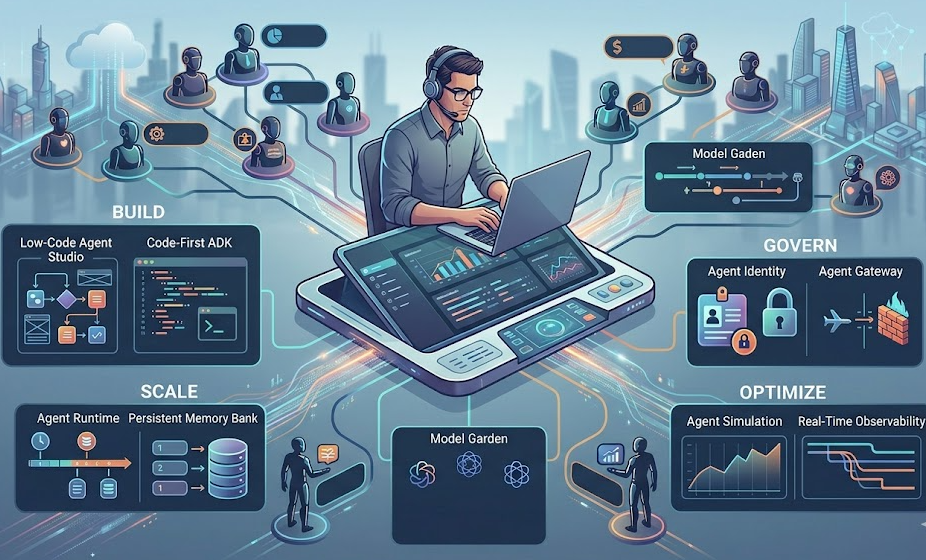
Moving forward, Gerstenhaber said, all of the services previously housed in Vertex AI, along with all of its future roadmap developments, can now be found within the Gemini Enterprise Agent Platform, along with everything needed to deliver multi-agent teams into the enterprise. The revamped platform is much more than just a facelift, with Gemini Enterprise Agent Platform designed to provide the infrastructure that handles the entire lifecycle of AI agents. According to Gerstenhaber, Google has broken this down into four main pillars: Building, scaling, governing and optimizing autonomous workforces.
For those building AI agents, the main focus is on the new Agent Studio and Agent Development Kit or ADK – both of which have received significant upgrades. The first is designed for regular business users that need to design their own agents, and includes a low-code visual interface that makes it simple to drag-and-drop agent logic into place. For hardcore developers, the ADK is where it’s at. Builders will be able to unlock more powerful reasoning by accessing the most powerful AI models and organizing their agents into a network of sub-agents capable of solving complex problems, using its new graph-based framework.
Gerstenhaber said the new ADK supports native ecosystem integrations that make it simple to connect AI agents to internal data without building custom pipelines. Users will also be able to activate their data in platforms such as BigQuery and Pub/Sub with batch and event-driven agents in order to run massive, asynchronous tasks such as content evaluation and data analysis in the background.
To scale AI agents from a fancy proof-of-concept to live environments, users need a platform that’s able to handle the performance, state and security requirements of real-world work, and Gemini Enterprise Agent Platform delivers here too. It features a revamped Agent Runtime for the simple provisioning of new agents, plus support for multiday workflows to keep them running autonomously for days on end. There are tools for agent-to-agent orchestration too, enabling agents to easily delegate tasks to one another, so multiple specialized agents can work with one another on the most complex tasks given to them.
To support the context required for agents running at large scale, Google has created a new Agent Memory Bank that dynamically generates and curates long-term memories from conversations. This can be accessed by tapping into new “Memory Profiles” that allow agents to recall high-accuracy details with low latency, ensuring that context is never lost.
For governance, the Google Enterprise Agent Platform offers a secure-by-design architecture that applies enterprise policy controls to each agent that’s deployed, whether customers build them themselves or source them from Google’s partner ecosystem. These controls make it simple to assign each agent with an Agent Identity, just like each human has their own. Gerstenhaber explained that each agent receives its own, unique cryptographic ID that leaves a clear and auditable trail for every action it takes, and that these can be mapped back to predefined authorization policies.
Users will also be able to maintain a central library of approved tools agents can access through the new Agent Registry, Gerstenhaber said. It indexes each internal agent, tool and agent skill, simplifying the discovery process while ensuring they can only access approved assets. Meanwhile, the Agent Gateway is designed to act like an air traffic control tower, allowing administrators to oversee their entire fleet of AI agents and enforce consistent security policies across them all. There’s also a comprehensive range of tools for protecting agents against prompt attacks and monitoring their behavior in real time, found under the Agent Security dashboard.
Finally, for optimizing agents, the Google Enterprise Agent Platform provides tools for testing them before they’re shipped and then monitoring their performance in production environments. With Agent Simulation, users can test how their agents work on synthetic workloads using virtualized tools in a controlled environment. Once they’re up and running, they’ll be able to use the Agent Evaluation tools to continuously score each agent as it performs its work.
The Agent Observability tool enables them to dig even deeper and visually trace the complex reasoning of each agent and debug issues as they occur. Should an agent fail to perform as expected, users can then pull up the Agent Optimizer to automatically refine its system instructions and enhance its accuracy.
Although Google will undoubtedly push customers to use its fleet of Gemini models, it’s still maintaining its commitment to an open model ecosystem. Users will be able to enjoy “first-class access” to a selection of more than 200 models, including Gemini 3.1 Pro and Gemini 3.1 Flash, its open-source Gemma 4 models and Lyria 3 for creating music and audio. It also lists numerous third-party models, including Anthropic PBC’s Claude 3.5 Sonnet and Haiku.
Support our mission to keep content open and free by engaging with theCUBE community. Join theCUBE’s Alumni Trust Network, where technology leaders connect, share intelligence and create opportunities.
Founded by tech visionaries John Furrier and Dave Vellante, SiliconANGLE Media has built a dynamic ecosystem of industry-leading digital media brands that reach 15+ million elite tech professionals. Our new proprietary theCUBE AI Video Cloud is breaking ground in audience interaction, leveraging theCUBEai.com neural network to help technology companies make data-driven decisions and stay at the forefront of industry conversations.