 AI
AI
AI
AI






AI

The artificial intelligence era is widening the gap between winners and laggards, and the delta is not only determined by who has the most AI but also how deeply AI is embedded into business processes. That’s according to IBM Corp. Chief Executive Arvind Krishna at the day 1 keynotes from IBM Think 2026 in Boston.
His talk kept coming back to the operating model change that helps organizations move past experimentation and pilots and into end-to-end workflows where AI changes decisions, cycle times and outcomes. IBM positioned this as a “day zero” moment: AI is here now, but most enterprises are still using it at the margins, and the opportunity window won’t stay open forever.
Krishna (pictured) laid out the bridge between the past and the future in three vectors:
One of the keynote segments that resonated the most was Krishna’s operating model argument. IBM’s claim is that AI is shifting from a technology initiative to “the business model,” and that’s why the old internal metrics — budget size, team size — are less important than whether the business is essentially AI-wired, end-to-end. IBM pointed to internal productivity gains of $4.5 billion and framed AI as a growth lever, with many organizations intending to reinvest productivity into new products, new services and new revenue streams.
The customer example IBM put forth was Aramco, positioned as an “AI-first enterprise” that has moved beyond pilots and put AI “in the field.” The emphasis was execution with Aramco saying “we’re not interested in PoCs…” we want to create value in the field. The company is emphasizing domain expertise, training small and medium-sized enterprises and using AI to compress cycle times and drive measurable value.
A recent McKinsey report explored what an AI operating model looks like. Here’s a graphic from that report:
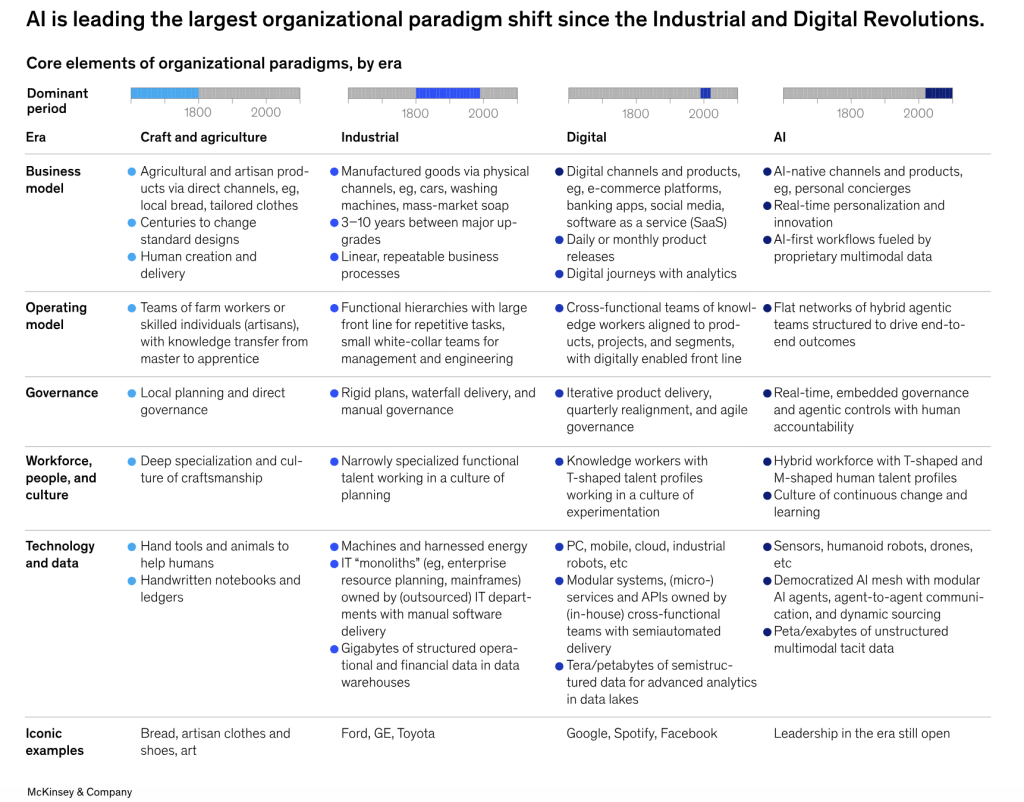
The point is this type of organizational change is non-trivial and will take the better part of a decade to play out. The only firms likely fitting into the new model paradigm are startups.
IBM’s hybrid message is that data lives everywhere and as such AI must be brought to the data. Resilience is IBM’s strength and single points of failure are real; so IBM’s hybrid offerings must be exceedingly reliable. The keynote connected hybrid to sovereignty and governance – and to IBM’s portfolio moves with OpenShift, the HashiCorp acquisition and Confluent (6,500-plus enterprise customers, 40% of the Fortune 500) to pull real-time streaming data into the AI foundation, paired with watsonx.data.
Elevance Health was the operational customer proof point — a member-facing virtual assistant that uses hundreds of data points to help members understand benefits and costs, plus provider interoperability via a data sharing layer (likely Snowflake), and agents monitoring payment integrity (fraud, waste, abuse). The common thread was to modernize the data and platform foundation, then embed AI in workflows with governance baked in from ideation through deployment.
IBM pushed back on both ends of the conventional wisdom spectrum, from “quantum is sci-fi” to “quantum is oversold” – arguing it has moved from science to engineering. In his keynote, Krishna asserted that quantum advantage is approaching quickly and positioned quantum and AI as complements – that is, quantum helps uncover what AI can’t compute, and AI accelerates progress on algorithms and workflows. Cleveland Clinic was the customer example, with quantum-enabled work on biomedical discovery and simulation at scale, framed as a significant change for understanding biology and therapeutics.
Krisha gave a nod to a few of IBM’s product announcements that were positioned as enablers of the operating model shift:
We believe IBM’s opportunity is to turn “AI-first+hybrid+governance” into a single, end-to-end story that closes the gap between AI ambition and operational execution. The keynote narrative pointed at the real barriers, including siloed data, fragmented infrastructure, and “multiple clouds with no coherent operating models” – and it made the claim that “the models don’t really matter unless a foundation is correct.”
The missing piece in our view is a Palantir-like harmonization layer that sits above systems of record and above the modern data platform, harmonizes meaning across domains, and becomes the “system of intelligence” feed trusted data to agents that can operate in a governed and safe manner. In plain terms, enterprises need a way to reconcile disparate data into a usable, policy-controlled representation of the business – not another pile of connectors pulled into a data store.
IBM has the ingredients to own that layer credibly, but it has to be articulated as a productized integration story, not a collection of parts:
With its key pieces of the stack, including watsonx.data, IBM can win mind share by positioning itself as the vendor that operationalizes AI through a governed, context-driven integration layer. It can be a practical bridge between messy enterprise data and agentic aspiration. The keynote showed components and the opportunity is to make the harmonization layer an explicit system of intelligence that delivers unique and powerful value where data, process, identity and policy come together.
IBM’s Think 2026 keynote laid out a coherent three-part premise including: 1) An AI-first operating model change; 2) Hybrid as a durable architecture; and 3) Quantum as an engineering timeline, not a science project. The keynote thread was that AI value doesn’t show up at scale until organizations stop treating it as a separate thing – and start treating it as the core of a firm’s operating model. IBM is aiming to be the day zero to scaled deployment partner for enterprises that want to move fast without losing control.
Action item: Chief information officers should pick one cross-functional workflow that can deliver substantial value to the business (not a RAG-based chatbot) and run a 60- to 90-day integration-first sprint to prove you can harmonize data, policy and execution across systems. The deliverable is an operating capability with a shared data and ontology layer that standardizes entities, permissions and process context so AI can act safely and repeatably.
Measure success in two ways including: 1) Time-to-outcome improvement (cycle time or cost reduction) and 2) The percentage of the workflow that can run end-to-end with auditability. It’s likely you’ll discover the capabilities to accomplish this are lacking, but it will expose the gaps in your AI tech stack that you can partner with firms such as IBM to close.
Support our mission to keep content open and free by engaging with theCUBE community. Join theCUBE’s Alumni Trust Network, where technology leaders connect, share intelligence and create opportunities.
Founded by tech visionaries John Furrier and Dave Vellante, SiliconANGLE Media has built a dynamic ecosystem of industry-leading digital media brands that reach 15+ million elite tech professionals. Our new proprietary theCUBE AI Video Cloud is breaking ground in audience interaction, leveraging theCUBEai.com neural network to help technology companies make data-driven decisions and stay at the forefront of industry conversations.