 AI
AI
AI
AI







AI

Red Hat Inc. is emerging as a key player in the enterprise AI infrastructure space as organizations face increased pressure from their boards of directors to demonstrate value from AI investments.
The company is positioning its open hybrid cloud as the control layer organizations need to connect AI agents, cloud-native apps and legacy systems. At the same time, the fast pace of AI deployment is overwhelming IT teams that are trying to learn new AI tooling while resolving years of technical debt from modernization projects of the past.
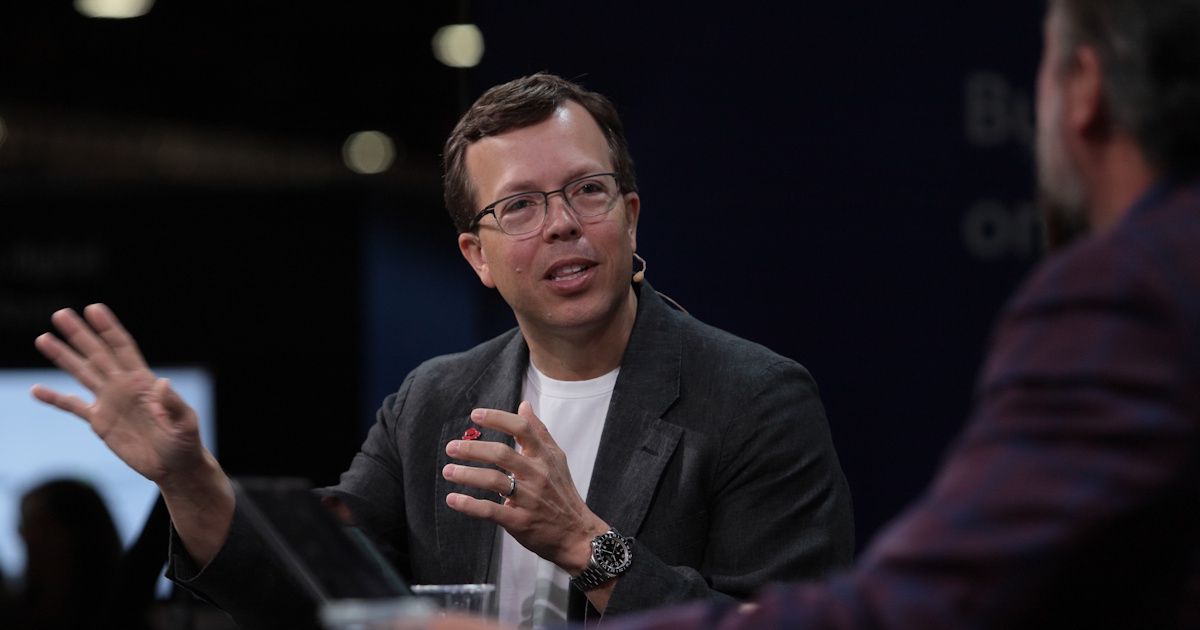
These pressures call for a back-to-basics approach with a focus on fundamental IT maintenance, explained Matt Hicks (pictured), president and chief executive officer of Red Hat, in an interview with theCUBE’s Rob Strechay and Rebecca Knight at Red Hat Summit 2026, during an exclusive broadcast on theCUBE, SiliconANGLE Media’s livestreaming studio.
“From the board level down … you have a feeling of, ‘We have to be able to harness what this technology can do,’” Hicks said. “They apply that top-down pressure, and then if you are in the IT team, for the last 10 years, we have been trying to get to cloud or ending up in multiple spots, dealing with tons of technologies, but not always maintaining technical debt. That is all crashing down on them at the same time.”
Here’s theCUBE’s complete video interview with Matt Hicks:
Red Hat is well positioned to support enterprise AI infrastructure modernization because of its legacy in open source, added Gunnar Hellekson, vice president and general manager for Red Hat Enterprise Linux at Red Hat.
“Open source and specifically Linux is the foundation for all AI innovation that’s happening now,” Hellekson told theCUBE. “The entire ecosystem of AI software that’s being developed is all out in open-source today. The most meaningful contributions are happening through open source. That makes the operating system a natural collection point for all that innovation.”
Here’s theCUBE’s complete video interview with Gunnar Hellekson:
In interviews at Red Hat Summit, Strechay and Knight spoke with industry experts from Red Hat, Advanced Micro Devices Inc., Intel Corp., Google LLC, IBM Corp. and Microsoft Corp., among others. They discussed how enterprises are solving for rapidly increasing AI costs and why businesses increasingly value product choice and flexibility when it comes to purchasing hardware, AI agents and tooling. (* Disclosure below.)
Here are three key insights you may have missed from Red Hat Summit:
The race to deploy AI meant massive initial spend on compute resources. But as workloads multiply and inference costs rise, enterprises are now re-evaluating the economics around AI. A more effective strategy is mapping specific AI use cases to the right hardware, explained John Hampton, corporate VP of global enterprise technical sales at AMD.
“So many of these enterprises just ran out and bought big GPU clusters because they knew they had to solve for AI,” Hampton told theCUBE. “Enterprises are coming to us and saying, ‘This is exploding. It’s good that we’re using AI, but we can’t afford this anymore.’”
What enterprises want now is the ability to choose the right CPUs or GPUs for the right task. To that end, AMD’s partnership with Red Hat allows the organization to offer a range of compute options backed by Red Hat’s open software stack, according to Hamptom.
Here’s theCUBE’s complete video interview with John Hampton:
Similarly, a collaboration between Red Hat and Intel also promises to help organizations determine the right combination of hardware and software for their use case. In some cases, that may mean moving certain AI workloads away from GPUs toward the CPUs many businesses already have in their data centers, explained Bill Pearson, VP of data center and AI at Intel.
“As we’ve gone through this with our customers in the industry, we’ve seen that people often have just assumed, ‘I’ve got a hammer. I need the nail to hit it with,’” he said. “Once they take a step back to say, ‘Wait a minute. I have these CPUs in my data center’ or ‘I need to figure out how to balance the right number of CPUs with the right number of GPUs to achieve that outcome I’m looking for,’ they’re actually going to get better results at a better price point for delivering lower-cost tokens.”
Here’s theCUBE’s complete video interview with Bill Pearson and — Taneem Ibrahim, director of engineering for AI inference at Red Hat:
Ultimately, the economics of inference are forcing enterprises to make deliberate decisions throughout the tech stack, from hardware to agents to deployment environments. Red Hat’s converged platform is able to serve as the foundational layer helping enterprises connect it all together, explained Chris Wright, chief technology officer and senior VP for global engineering at Red Hat.
“Heterogeneity absolutely is the future,” Wright told theCUBE. “Building heterogeneity, not just in hardware, but in the workloads and the kind of models that you use to support your workloads — the bigger ones, the smaller ones, tuned for a specific task — that’s exactly what we’re focused on.”
Here’s theCUBE’s complete video interview with Chris Wright:
Enterprises’ desire for choice isn’t limited to CPUs or GPUs – it also includes the flexibility to choose the right agent for the right task. Through its Google Cloud Marketplace, Google has introduced the Gemini Enterprise Agent Platform to offer more than 2,000 agents from partners such as ServiceNow Inc. and Oracle Corp. that are ready-made for enterprise deployment.
AI is creating a transformational moment akin to the Industrial Revolution, according to Dai Vu, managing director of the Cloud Marketplace at Google Cloud. The hyperscaler has made a big bet that its cloud marketplace can help enterprises rapidly and efficiently scale to meet the moment.
“Think of it as an end-to-end platform to enable companies to build, scale, govern and optimize agents,” Vu said. “From there, we can put these agents into everyday workflows.”
Here’s theCUBE’s complete video interview with Dai Vu:
Meanwhile IBM is pursuing an infrastructure strategy to address the complexity created by the rapid pace of AI deployment, explained Ignacio Riesgo, senior director for developer advocacy, IBM and Red Hat application development, at IBM.
“If you think about one year ago, we were talking about modernization as one of the critical areas. This year we are completely changing the pace,” Riesgo told theCUBE. “We are talking about agents; we are talking about LLMs. The conversation has evolved and now the level of complexity is in another level.”
To address that, IBM announced a fully managed OpenShift Virtualization service on IBM Cloud that is designed to help make enterprise AI deployments scalable, secure and resilient. This could help enterprises address the considerable pressure IT infrastructures are under, added Jason McGee, IBM fellow, CTO for IBM Cloud and GM for cloud platform and common services at IBM.
“I think many people have talked about how even the ratios between GPUs and CPUs are shifting very quickly from maybe eight GPUs for one CPU to one-for-one, and that’s being driven by agents making lots of API calls and tool calls and driving backend systems,” McGee said. “AI is kind of enabling those agents to do the work and all of that is pushing on infrastructure.”
Here’s theCUBE’s complete video interview with Ignacio Riesgo and Jason McGee:
Red Hat is looking to deliver better efficiency and control to AI deployments with Red Hat AI 3.4, a platform that supports large-scale inferencing and AI agents across hybrid cloud environments. A single horizontal cloud platform can provide the foundation enterprises need to take AI out of the experimental phase and into production, explained Stephen Watt, VP and distinguished engineer, Office of the CTO, at Red Hat.
“Every department’s doing their own experimentation, their own pilots, but everybody’s going about it a different way,” Watt told theCUBE. “Everybody will emerge from the pilot phase, and there’ll be some shared observations. Once that’s done, central IT can … use that to figure out what platform we buy and drive total cost of ownership and increase efficiency.”
Big gains can come from building on a shared platform foundation instead of relying on isolated pilots. As one example, Red Hat worked with One New Zealand Group LLC to deploy a horizontal telco cloud platform built on Red Hat OpenShift for a 5G automation project that resulted in a 40% improvement in delivery time and a 30% to 40% improvement in operational costs.
Here’s theCUBE’s complete video interview with Stephen Watt:
Similarly, Banco Bradesco S.A., has been able to stand up an internal AI platform using Microsoft and Red Hat. Its developers are able to provision any AI model or backend service, and an Azure AI governance layer provides the guardrails to keep it all controlled. The bank’s efforts earned a platform innovation award from Microsoft and Red Hat, according to Campbell Vertesi, CTO of the Microsoft and Red Hat partnership at Microsoft.
“They got to … 100 AI services in production within one year, 200 by the second year,” he said. “I just heard at the award show the other night, they’re at 500 plus now. That’s two and a half years. Those are in production, compliant, audit-ready solutions. That is amazing — and it’s only possible when you embrace that level of customizability and using both of the stacks together to get exactly what you need.”
Here’s theCUBE’s complete video interview with Campbell Vertesi:
Catch up on our complete video coverage of Red Hat Summit:
(* Disclosure: TheCUBE is a paid media partner for the Red Hat Summit 2026 event. Sponsors of theCUBE’s event coverage do not have editorial control over content on theCUBE or SiliconANGLE.)
Support our mission to keep content open and free by engaging with theCUBE community. Join theCUBE’s Alumni Trust Network, where technology leaders connect, share intelligence and create opportunities.
Founded by tech visionaries John Furrier and Dave Vellante, SiliconANGLE Media has built a dynamic ecosystem of industry-leading digital media brands that reach 15+ million elite tech professionals. Our new proprietary theCUBE AI Video Cloud is breaking ground in audience interaction, leveraging theCUBEai.com neural network to help technology companies make data-driven decisions and stay at the forefront of industry conversations.